Whether brandished by Lee Marvin in “The Professionals” or wielded by William Holden in “The Wild Bunch,” the Winchester Model 97 Riot Gun is the “bad boy” of smoothbores, but paradoxically, it was a favorite of early 20th century law-enforcement agencies. Yet in its standard 30-inch-barreled configuration, the 12-gauge version of John Browning’s exposed-hammer pump-action design was one of the most popular sporting shotguns in America.
The Model 1897 was a much-needed evolution of Browning’s Model 1893, a weaker gun designed for blackpowder shotshells. By contrast, the Model 97 had the improved strength and metallurgy required for the then-new smokeless propellant shotshells. Its action locked up tightly and required a slight forward movement of the automatic slide lock (usually recoil was enough) to free the pump handle for cycling.
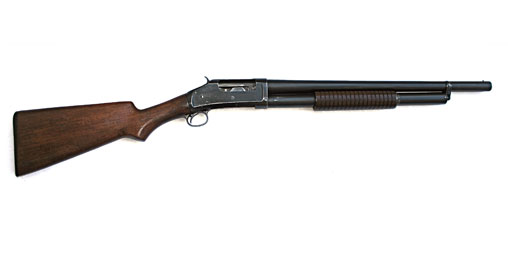
From 1898 through the 1960s, Winchester offered its Model 1897 as a Riot Gun (take-down versions were added after 1935) with a cylinder-choked 20-inch barrel. There was no trigger disconnector, which meant that by holding the trigger back the gun could be slam-fired as fast as the pump could be worked. With the ’97s standard five-round-capacity tubular magazine and a sixth shell in the chamber, the Riot Gun was a formidable arm indeed. During World War I it evolved into the Model 97 “trench gun,” complete with a bayonet lug, sling swivels and a perforated steel heat shield covering the barrel.
In civilian life, the Riot Gun was used by law enforcement groups as diverse as the Texas Rangers, the Union Pacific Railroad and various express companies. Not all of these guns were marked. Unfortunately, the popularity of cowboy action shooting, which favors these fast-shooting, jam-resistant smoothbores, has caused a number of longer-barreled sporting models to have their tubes trimmed to riot-gun length. Factory riot guns have rounded muzzles and are stamped “CYL.”
The Model 97 Riot Gun shown here was made in 1924 and was used by the Pasadena, Calif., Police Dept. It was purchased three years ago for $1,000. It retains an unusual amount of finish (most law enforcement guns are fairly worn), leading one to speculate that it spent more time in a station gun rack than in a patrol car. As such, and with its documentation, it is easily worth $1,200 on today’s market.
Gun: Winchester Model 1897 Riot Gun
Gauge: 12
Condition: 80 Percent - NRA Very Good (Modern Gun Condition Standards)
Manufactured: 1924
Value: $1,200 (With Pasadena P.D. authentication; $750 if no L.E. provenance)
Most Popular