** When you buy products through the links on our site, we may earn a commission that supports NRA's mission to protect, preserve and defend the Second Amendment. **
Gallery
1 of 1
Getting Started
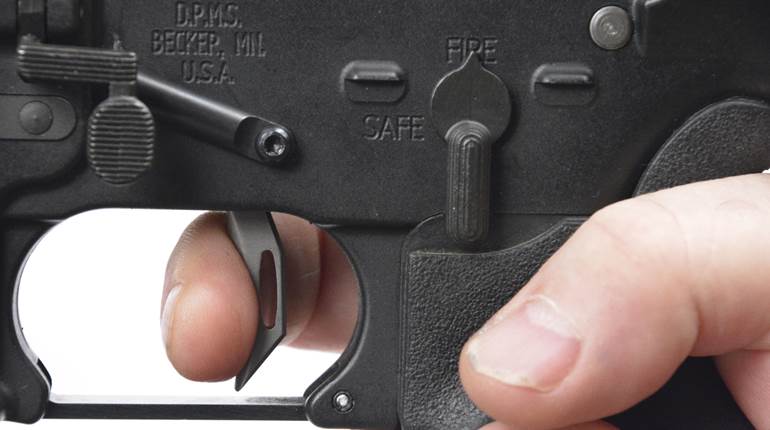
Trigger parts for an AR-15 are machined from stacks of 1/4-inch stock in a computer-controlled Electric Discharge Machining (EDM) center. The operator sets up the machine just before going home for the day, and by the next morning the parts are complete.
1 of 1
In Charge
Chief Engineer and shop manager Calvin Motley shows a part made from the huge machining center behind him. Motley is responsible for designing every new trigger the company produces.
1 of 1
Lasting Impression
A completed housing—including the laser-etched company logo—for an AR-15 trigger comes out of the CNC machining center. All that’s needed now is deburring and anodizing.
1 of 1
No Easy Feat
Stock material in bar form is stacked and drilled in this CNC machine. Once drilled, the stock can be cut to profile in an EDM machine—two machines, two set ups, several operations, producing dozens of identical parts.
1 of 1
Talk About Multitasking
This machine has 14 different tools performing separate operations on a given part. As each tool is rotated into position it indexes off a common point, and the computer operates the tool to precisely perform the operation.
1 of 1
Putting It All Together
Kevin Dee sets a Timney Trigger assembly in a Remington Model 700 barreled action. Each trigger goes through his hands and is set in a test action for the specific rifle it is designed for.
1 of 1
Custom Built
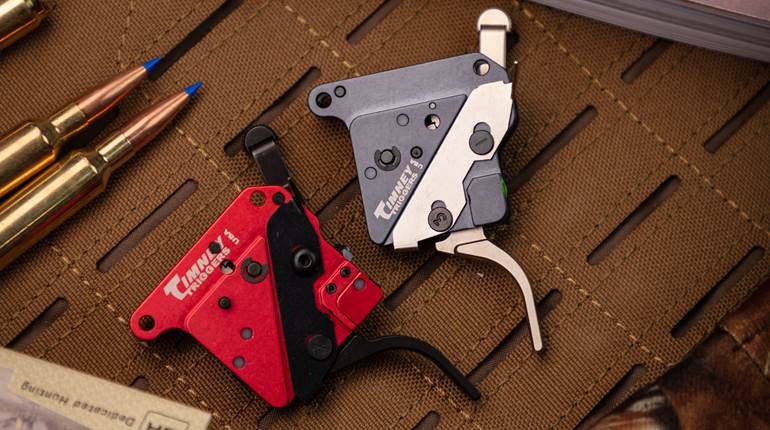
Customers can order a trigger set to a specific let-off weight, within certain limits. Nonetheless, Timney Triggers are built to allow the customer to adjust trigger-pull weight, creep and overtravel.
1 of 1
Hands On
With bowls and trays of parts in front of her, Cecilia Soto Rodriguez assembles each trigger package at the facility. The parts are so well-fit and identical she can put one together in less than a minute.
1 of 1
Finishing Touches
Rodriguez presses the pins of a trigger assembly in place with a small arbor press. Even with all the high-tech computer equipment, sometimes 19th century technology is still the best.
Ruger announced a major change to several of its longtime product lines this week, stating that it would immediately suspend production of several models while finishing out current production runs of other models through 2026.
In the late 1880s, the British military adopted its first bolt-action rifle chambered for the .303 British cartridge. This is the Lee-Metford, the first step on the way to the iconic Lee-Enfield.
Guatemala’s military recently acquired more than 2,000 Colt M4A1 rifles through the U.S. government's Foreign Military Sales program as part of the country's ongoing military modernization efforts.
The NRA today released a new 30-second ad highlighting Democrat U.S. Senate candidate James Talarico’s longstanding support for banning so-called “assault weapons” and standard-capacity magazines—the firearms and accessories owned by millions of law-abiding Texans.
Springfield Armory has expanded its Echelon line of handguns with several new Echelon Pro Comp offerings, bringing a number of what the company calls "performance-oriented enhancements" to the platform.
These days, it’s safe to say that injection-molded polymer of some sort is the most prevalent material from which to construct a pistol frame, but lately, that trend seems to be reversing. Metal is back.