You see now how right we were when we said you would have to wait for your news of the war. It is true thousands of columns of alleged war news are printed every morning. The informing character of this material is below par.
Naturally no other subject is of so much consequence to the world as this struggle between giants. Boiling down to its bare bones all that reaches us the developments of the last week are: The advance of the German line through practically all its length upon France; the entrance of the Russians into Germany and Austria; the defeat of the Austrians by Servia (a most gallant feat on all accounts and likely to be overlooked in the midst of other swiftly moving events) ; and the declaration of war upon Germany by Japan. In the last lies the most distinct menace to the peace of the United States of all the dangers of involvement which this war has brought.
England is a friend to us, and Japan says she will always hold us as a friend. Japanese success in the Orient is liable to change her attitude toward many questions; meanwhile, merely to touch the outer margin of this dangerous topic, it should not be forgotten that we are pledged to maintain the integrity of China.
All this should bring home to Americans who have preached peace and ridiculed the possibility of war the difficulties which surround a nation forced to fight without adequate preparation.
Look at Great Britain now, strong, masterful, virile (she is mistress of the seas, it is true, by virtue of preparation there) ; on land a paltry hundred thousand men or so are all she could contribute to the strength of the allied armies.
True, she is bestirring herself and within a few months will be able to put half a million more men in Europe, but she cannot land a trained army there inside of six months. Meanwhile war begun and carried on by trained millions may easily have ended.
Fancy for a moment our condition, if we should be suddenly upon some early morning, as we might well be, confronted by the necessity of taking up the part of a full-grown nation in this embroglio. How long would it take us to put an army of two million trained men in the field ?
Under the spur of great necessity a year might let us get the men together and train them in the essentials, but not less than two years would suffice for making and equipping an army which would do us credit.
Does anyone remember in these times what a certain mouthy but irresponsible ex-ironmaster said would happen to an army which started to march from our east coast to the interior?
Do you recall how graphically he described the way each citizen would seize a gun and lend his immediate aid to the complete annihilation of that army?
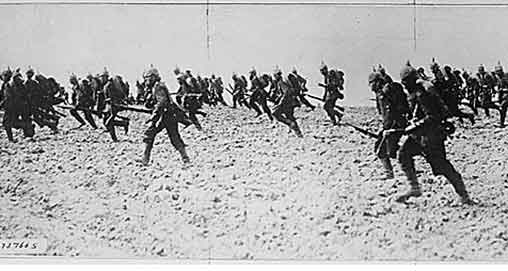
One wonders whether the individual in question has paid any attention to what has been occurring in Belgium. Wherever citizens outside of the military forces of that country offered any opposition, violence was done not only to them, but to their houses and to their families. Men, women and children were destroyed.
A military machine such as the Germans have built cannot be stopped by unorganized resistance. No matter how brave the men are who offer that resistance it can only be met and stopped by another machine.
All would be willing to admit, even the most ardent militarist, that war is wrong and should be abolished, but none can deny that war can be waged successfully only by officers and men trained to be proper parts of an effective military machine. That training, except in rare cases-instances so rare that they may be excluded from the argument-can never occur after war has begun. It must, especially under modern conditions, be effected during peace.
Moreover, efforts to make a military machine must not stop with training a portion, even a considerable portion, of the men of the nation.
A great German, Von der Goltz, in his "Conduct of War," said:
"The best military organization is that which makes all of the intellectual and material resources of the nation available for the purpose of carrying a war to a successful issue."
Even those who run may read that the Germans have fully lived up to this saying. They, through intelligent preparation, are now able to make available "all of the intellectual and material resources of the nation."
What about the rest of us?
Arms And The Man
August 27, 1914
Most Popular