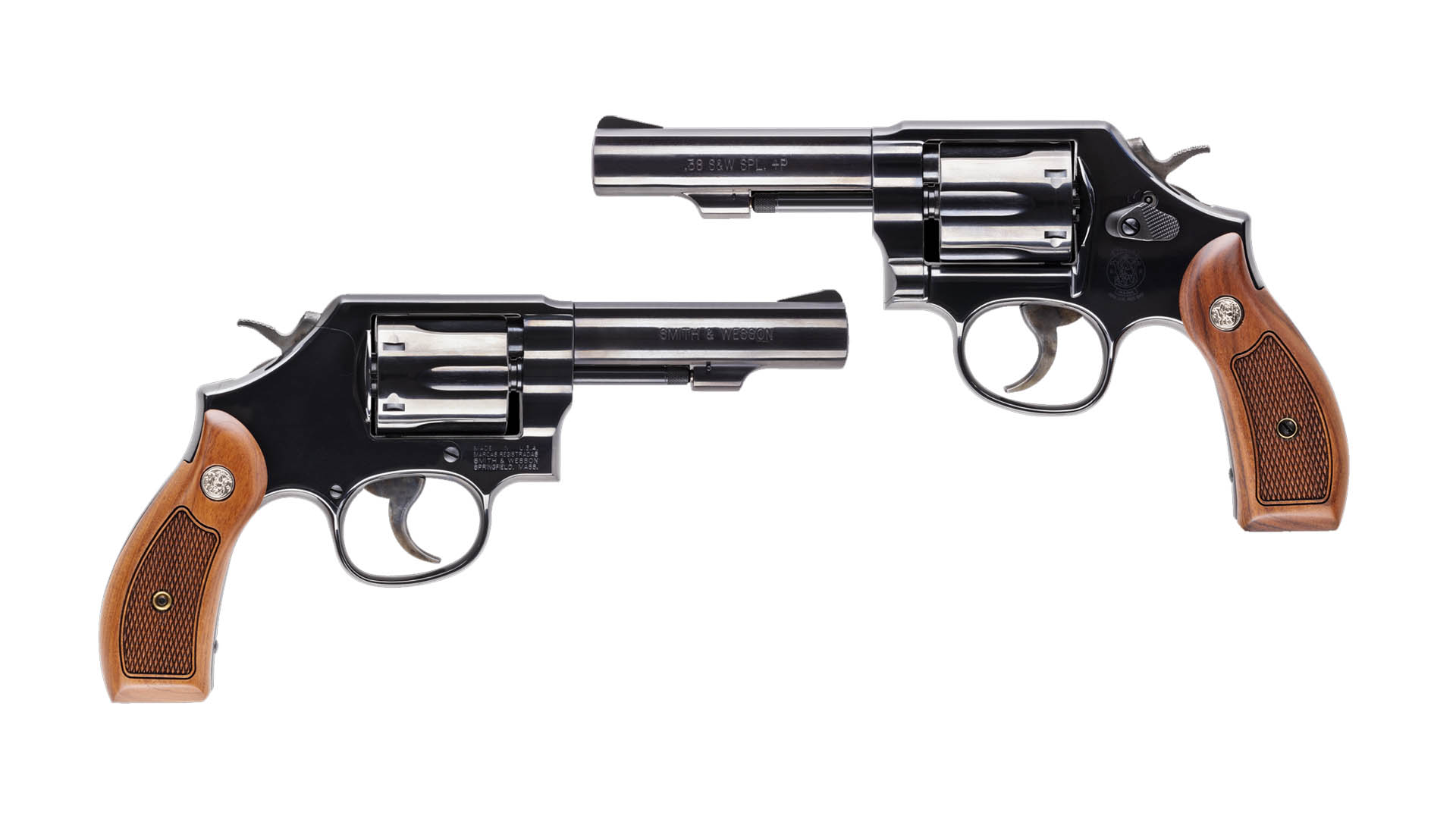
Smith & Wesson introduced its K-frame .38 Military & Police (M&P) revolver in 1899. It was available with either 4", 5", 6", 6 1/2" or 8" barrels, finish was blued and the grip was rounded. A similar design in .32 WCF appeared the same year, but sales paled by comparison to its bigger brother that grew to become the company’s most famous handgun.
The .38 M&P was chambered for a new cartridge at the time, the .38 Smith & Wesson Special—referred to today as the .38 Spl. The double-action revolver featured all the ingredients, construction and reliability mandatory for duty. The U.S. Navy purchased 1,000 the next year. In 1901, the Army followed suit by procuring 1,000, an unofficial endorsement that didn’t escape the notice of civilian enthusiasts. Many more orders from the U.S. military followed, and commercial sales soared.
In 1904, a square butt was introduced as a grip option, a change designed to enhance control under recoil and improve follow-up shot speed. To say gun owners appreciated the configuration is understatement. It soon became the factory’s standard configuration, and it wasn’t long before demand forced the company to concentrate nearly all its production on the revolver.
As World War II unfolded, that unfailing performance wasn’t lost on our allies across the pond, either. In 1940, the company began producing a variant called the Smith & Wesson 38/200 British Service Revolver. That version was chambered in .38 S&W, which loaded a 200-grain bullet, instead of the revolver’s original .38 Spl. More than a half million were produced and shipped overseas before production stopped in 1945.
Sometime during the war, the company shipped its millionth .38 M&P, at which point it began adding the letter V—for Victory—to serial numbers. After hostilities ended, the company introduced several variants, but continued to improve upon the original, harnessing the latest metallurgy and engineering each stop of the way.
The first to wear the Model 10 name came out of the factory in June 1957. It’s still built on that legendary K-frame and packs the .38 M&P reliability that endeared it to enthusiasts. Sales continue to be brisk to this day, partly due to that legendary history, but it’s the unfailing performance has gained the attention of a new generation of shooters. The fact .38 Spl. loads are light years ahead of where they were only a few years ago doesn’t hurt, either.
Today’s Model 10 chambers .38 Spl. and can handle +P loads. Cylinder capacity is six cartridges in the single/double action. Its frame, cylinder and barrel are carbon steel, blued in classic fashion and the grips are wood. It’s a timeless look.
Sights are a black blade up front and the rear is fixed. Overall length is 8.9", the barrel measures 4 and it tips the scales at 34.4 ozs. MSRP is $812.
Most Popular