Pistol marksmanship competition in America was not always under the stewardship of the NRA. Before World War II, an organization called the United States Revolver Association was the governing body for most firearms competitions in the country. They even conducted the trials and organized our Olympic teams. Founded in New England in 1900, the USRA is still in existence and still shooting matches. It is no longer on the national scale, but this legendary body is a big part of handgunning history.
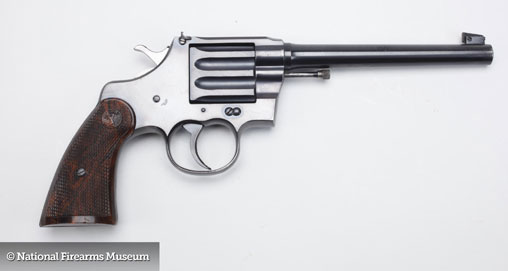
Part of the old program of USRA matches was the slow-fire, single-shot type, fired with special .22 rimfires at (I believe) 50 yards. The target was small and great accuracy was required. Both Smith & Wesson and Colt developed special guns for the job. As a matter of fact, S&W had several single shot .22s over the years, most of which tipped the barrel down to open for loading and unloading. The last such gun was the .22 Straight Line, which had the external contours of an auto, but pivoted the barrel sideways to load and unloaded. That’s unusual, but not as different as the Colt Camp Perry model. This pistol had the revolver-like appearance of a medium-frame Official Police or Officer’s Model Match. It differed in that it had no cylinder, just a steel block that filled the cylinder window and swung out to the left. The barrel was screwed into this breech block and moved when it was opened. Unusual.
The gem of the .22 single-shots was the Harrington & Richardson USRA model. Another break open with downward tilting barrel, the USRA was designed by handgun authority Walter Roper. It had a number of interesting innovations in design, rifling, sights and a clever interchangeable grip feature. I have fired one of these extensively and consider it to be a minor masterpiece of design.
Most Popular