by
Support NRA American Rifleman
DONATE
** When you buy products through the links on our site, we may earn a commission that supports NRA's mission to protect, preserve and defend the Second Amendment. **
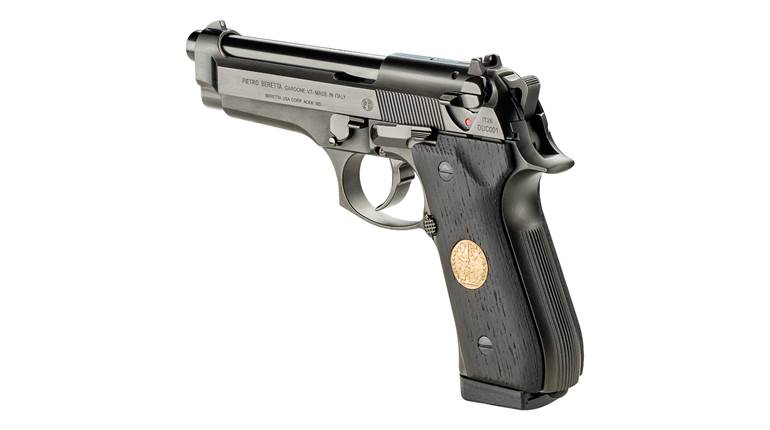
Having built firearms and firearm components since at least 1526, Beretta is the oldest continuously operating firearm company in the world today. Since the beginning of this long, storied history, Beretta has produced military arms. When the U.S. Army announced that it would be conducting testing for a new standard issue sidearm to replace the Beretta M9 handgun, Beretta entered once again with a new model handgun.

The handgun that Beretta submitted for evaluation in the Army's XM17 Modular Handgun competition is the APX. The APX is a semi-automatic, polymer-frame, striker-fired handgun. This was a new flavor for Beretta, as it had previously preferred hammer-fired single- and double-action handguns for its fullsize, center-fired offerings like the Model 92, 96 and PX4.

The APX, along with being striker-fired, uses a double-action-only trigger, which makes it different from previous Beretta fullsize handguns. It comes chambered in either 9 mm or .40 S&W, with a 17-round magazine capacity for the 9 mm version and 15 rounds in the .40 S&W version. The overall length of both versions are 7.5" with a 4.25" barrel. The 9 mm version of the APX has an empty weight just beneath 28 oz.

One of the most notable features on the APX are the rather large and wide slide serrations that nearly run the entire length of the slide front to back. The slide also has a set of drift-adjustable three-dot sights. The dot on the front sight is larger than the two on the rear sight. This makes the front dot appear similar in size to the dots on the rear sight when the pistol is aimed at arm's length.

Inside the polymer frame, and a feature that resulted from the modular requirements in the Army's XM17 competition, the APX has a removable, stainless-steel chassis that contains the fire-control group and the rails on which the slide rides. This chassis is the serialized part of the handgun, allowing the APX to have the polymer lower frame swapped with a different size.

While the APX is currently only offered in two fullsize models, potential does exist for the line to expand into different series of sizes while all being compatible with the same serialized chassis. The frame features a Picatinny rail system on the dustcover for lights or accessories. It also features an adjustable back-strap system that allows the grip size to be altered by the user to better fit their hands.
The APX can be configured for right or left handed use with the design's use of bilateral slide locks and reversible magazine release. With a fairly low bore-axis, the APX is fairly controllable and has mild recoil for a fullsize handgun. While the APX was not selected by the U.S. Army to replace the M9 service pistol, it is available to the market for purchase by civilians and professionals alike today. For more information on the Beretta APX, visit beretta.com.
To watch complete segments of past episodes of American Rifleman TV, go to americanrifleman.org/artv. For all-new episodes of ARTV, tune in Wednesday nights to Outdoor Channel 8:30 p.m. and 11:30 p.m. EST.
The handgun that Beretta submitted for evaluation in the Army's XM17 Modular Handgun competition is the APX. The APX is a semi-automatic, polymer-frame, striker-fired handgun. This was a new flavor for Beretta, as it had previously preferred hammer-fired single- and double-action handguns for its fullsize, center-fired offerings like the Model 92, 96 and PX4.
A disassembled view of the Beretta APX.
The APX, along with being striker-fired, uses a double-action-only trigger, which makes it different from previous Beretta fullsize handguns. It comes chambered in either 9 mm or .40 S&W, with a 17-round magazine capacity for the 9 mm version and 15 rounds in the .40 S&W version. The overall length of both versions are 7.5" with a 4.25" barrel. The 9 mm version of the APX has an empty weight just beneath 28 oz.
The large and spaced out slide serrations on the Beretta APX.
One of the most notable features on the APX are the rather large and wide slide serrations that nearly run the entire length of the slide front to back. The slide also has a set of drift-adjustable three-dot sights. The dot on the front sight is larger than the two on the rear sight. This makes the front dot appear similar in size to the dots on the rear sight when the pistol is aimed at arm's length.
Firing the APX, with the three-dot sights visible.
Inside the polymer frame, and a feature that resulted from the modular requirements in the Army's XM17 competition, the APX has a removable, stainless-steel chassis that contains the fire-control group and the rails on which the slide rides. This chassis is the serialized part of the handgun, allowing the APX to have the polymer lower frame swapped with a different size.
The stainless-steel chassis that serves as the APX's serialized part.
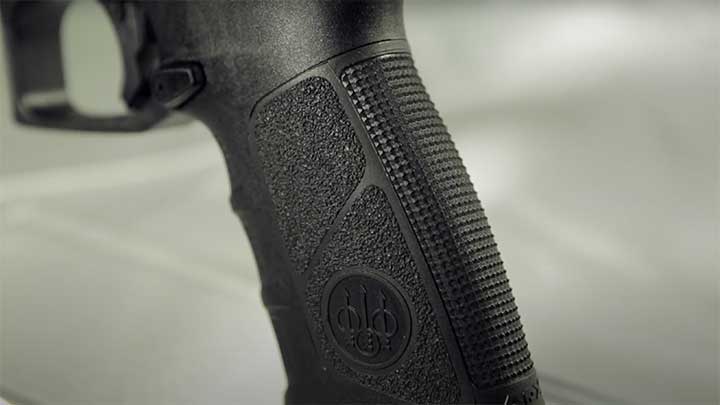
While the APX is currently only offered in two fullsize models, potential does exist for the line to expand into different series of sizes while all being compatible with the same serialized chassis. The frame features a Picatinny rail system on the dustcover for lights or accessories. It also features an adjustable back-strap system that allows the grip size to be altered by the user to better fit their hands.
the back strap of the Beretta APX can be swapped out to better fit the user's hands.
The APX can be configured for right or left handed use with the design's use of bilateral slide locks and reversible magazine release. With a fairly low bore-axis, the APX is fairly controllable and has mild recoil for a fullsize handgun. While the APX was not selected by the U.S. Army to replace the M9 service pistol, it is available to the market for purchase by civilians and professionals alike today. For more information on the Beretta APX, visit beretta.com.
To watch complete segments of past episodes of American Rifleman TV, go to americanrifleman.org/artv. For all-new episodes of ARTV, tune in Wednesday nights to Outdoor Channel 8:30 p.m. and 11:30 p.m. EST.