Rifleman Q&A: S&W M629 Markings

by
posted on December 23, 2022
** When you buy products through the links on our site, we may earn a commission that supports NRA's mission to protect, preserve and defend the Second Amendment. **
S&W M629

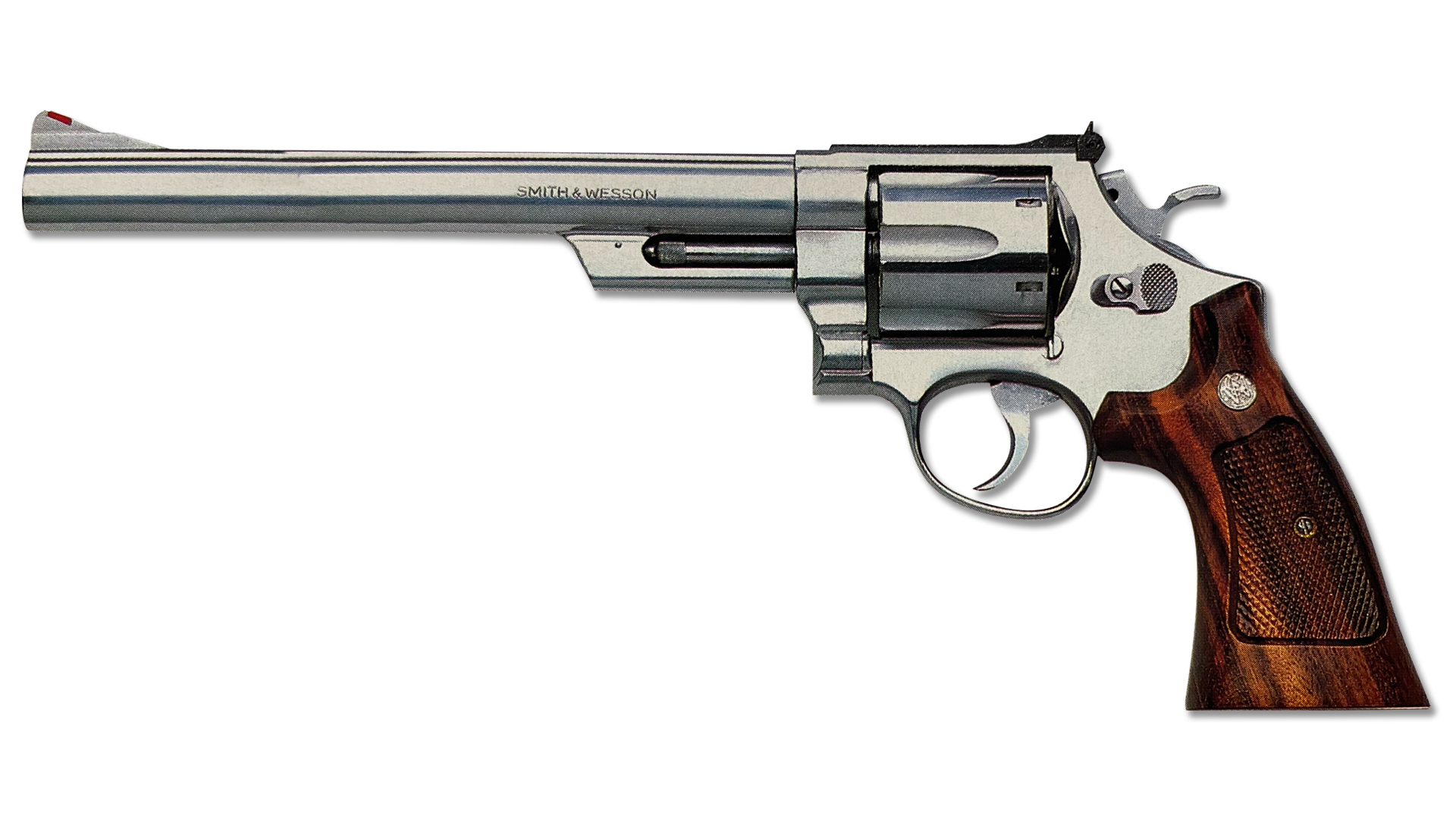
Q. I recently acquired a Model 629 Smith & Wesson revolver. It has the 83⁄8" barrel and S&W wood stocks. The yoke has “G23” over “42995,” and on the right side, it is marked with “AYF3198” over “M-629-1.” If I didn’t know it to be a 629, I would swear it was nickel; this is, by far, the brightest stainless gun I have seen.


A. The S&W Model 629 was introduced in 1979 as a stainless-steel version of the popular Model 29. Numerous engineering changes have occurred over the course of its production. The first, designated as the M629-1, occurred in 1982 and involved the elimination of the pinned barrel and chamber rim counterbores, along with a slight increase in cylinder length. The serial number AYF3198 does not help in determining the gun’s age, as there is no published listing of serial numbers by production date although, through research, I believe your S&W was produced in early 1988. The 629-1 was replaced by the -2 version in 1988. 

The twice-occurring G23 and 42995 were likely applied to verify that the yoke and frame were a matched set. Any other markings usually represent inspection and approval at different points of production.

At the time of your revolver’s production, there were no options available for degree of polish. Admittedly, it is possible to find variations in the level of polish due to normal human activity and tolerance of polishing equipment. Unless you are the first owner of the gun and can verify the level of finish, I suspect that the shiny appearance you describe was likely achieved through the efforts of a previous owner.

—John W. Treakle, Contributing Editor

Latest

Colt Detective Special Ihtog 1

I Have This Old Gun: Colt Detective Special

One of the iconic revolvers of the early 20th century is Colt's compact Detective Special, which became popular on the commercial market and was featured widely in film noir from the 1930s until the 1950s. But the road to the Detective Special wasn't the typical route for a new firearm.
The Real Deal: Mauser's M98 Das Original

In a world of modularity and strict cost-cutting, fine wood and machined steel firearms like the Mauser 98 are disappearing. The Mauser company is making sure the design lives on with the M98 Das Original.

’Merica! | America 250th Products from the Firearm Industry

From guns to knives to storage and beyond, show how your heart beats true for the red, white and blue as we celebrate 250 years of independence, liberty and patriotism with this assortment of commemorative products.

I Have This Old Gun: Witness to the Revolution

It is likely this Long Land Pattern Brown Bess was surrendered by British troops at Saratoga, then used to arm Americans in their fight for liberty before subsequently falling into private hands. Today, it remains as one of a scant few British muskets with a direct tie to the events of the American Revolution.

Rideout Arsenal Leaves Virginia

Rideout Arsenal recently announced it would be leaving the hostile political environment of Virginia for the Second Amendment-friendly state of Georgia.

The Guns of the American Revolution

Contrary to popular perception, the American Revolution wasn’t all muskets, bayonets and Mel Gibson running around with a tomahawk.

Interests


Get the best of American Rifleman delivered to your inbox.