Q&A: Properly Loading a Henry

by
posted on August 4, 2014
** When you buy products through the links on our site, we may earn a commission that supports NRA's mission to protect, preserve and defend the Second Amendment. **
qanda2015_fs.jpg

I know that the Henry rifle loads differently than other Winchester-style replicas. After reading Garry James’ article “Henry’s Classic Henry” (April 2014, p. 66), it made me wonder if there is a proper way to load my replica Henry?

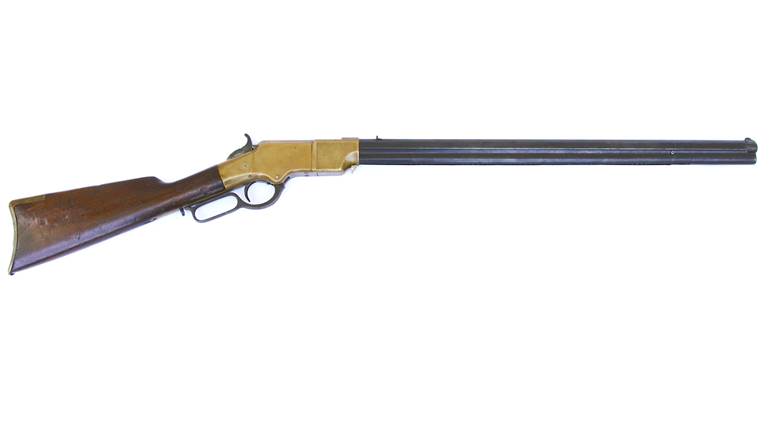
Unlike the “Improved Henry,” or Model 1866, and the subsequent Winchester lever-actions that feature Nelson King’s patented loading gate on the right side of their receivers, the Henry and its replicas are loaded by pushing a spring-powered brass tab—located under the barrel—up as far as it will go and then swiveling the top portion of the barrel/magazine tube assembly clockwise, which exposes the end of the magazine tube. Cartridges are then dropped down the tube, one by one, base first.

However, when loading the Henry, the barrel/magazine assembly should be held or tipped at a slight angle, to permit cartridges to gently slide down the loading tube, thus preventing them from dropping straight down with a force that could accidentally detonate a sensitive or projecting primer (especially prevalent in reloads, even with blunt-nosed bullets).

After loading, with the thumb still retaining the brass tab, pivot the top portion of the barrel/magazine tube assembly back to its original closed position. Then, still holding the brass tab and its spring-powered plunger with the thumb, gently lower the tab until the plunger is resting on the topmost cartridge, rather than letting it go with a dramatic “snap” that could also possibly detonate one or more of the stacked cartridges.

—Rick Hacker, Field Editor

Latest

1884 Trapdoor Springfield 1

I Have This Old Gun: Model 1884 Trapdoor Springfield

The U.S. military's first official breechloading service rifle was the Trapdoor Springfield, and of the line of guns that saw use throughout the late 19th century, one of the most refined was the Model 1884 Trapdoor.

A Retro Python: The Pietta Blacktooth Revolver

As the company did with the original Colt Single Action Army, Pietta sought to reproduce the Colt Python as closely to the original as possible with its new Blacktooth revolver.

Questions & Answers: Cylinder Swaps

I am a huge fan of anything .45-caliber, especially single-action revolvers. I have five Ruger Blackhawk revolvers in different barrel lengths, all chambered in .45 Colt, two of which have extra cylinders chambered in .45 ACP.

American Rifleman’s Editor Explains How This Historic Title is Staying Relevant

As the new editor in chief of American Rifleman—and former editor in chief of Shooting Illustrated—Ed Friedman has the critical and challenging task of bringing this storied title into the digital age.

Colt Gets $40 Million Contract for M4/M4A1 Carbines

Colt’s Manufacturing has been awarded a $40,863,564 firm-fixed-price contract with U.S. Army Contracting Command to produce M4/M4A1 carbines for sale to Bosnia and Herzegovina, Iraq, Macedonia and Tunisia.

The Stenzel Industries SAK-21: A Uniquely American AK

More than an American-made AK, Stenzel Industries calls the SAK-21 “a modular, purpose-built firearm, developed to meet the demands of special operations forces and professional shooters.”

Interests


Get the best of American Rifleman delivered to your inbox.