The gas cylinder on the M14 rifle, and also that on the M60 machine gun, look longer than the usual type. Do these guns use the same gas cylinder design? If so, how does it work? –F.C.E.
Answer: The gas cylinder design is essentially the same for the M14 rifle and the M60 machine gun, though dimensions are somewhat different.
The usual gas cylinder is operated by gas admitted when the bullet clears a gas port in the barrel. The gas at high pressure thus is admitted very suddenly, and its effect is that of a blow on the piston. This is not the most desirable way to put mechanical parts into motion, though it is effective and in fact it is the system used in most current gas-operated guns, generally quite successfully.
The M14 and M60 gas cylinders are distinctive in being designed to deliver a prolonged push instead of a simple blow. This prolonged push is accomplished by admitting the gas into a chamber of considerable volume, where it is allowed to expand and push the piston back.
Functioning of the M14 gas cylinder is shown schematically in the illustration. Gas from the barrel enters the floating piston through a hole in line with the barrel gas port, and fills the space within the piston and gas cylinder plug. The first movement of the piston takes the hole out of alignment with the gas port and cuts off admission of gas. The considerable volume of trapped gas expands smoothly and pushes the piston and operating rod to the rear. By the time the piston clears the exhaust port at bottom of the cylinder, the work of the gas has been done.
In this construction the dwell time (time between firing and beginning of movement of the mechanism) is about doubled. The velocity of the slide when it begins to unlock the bolt is only about half what it would be otherwise. Then the expanding gas continues to accelerate the parts, so that the over-all time cycle is substantially the same as from the impulse of a plain gas cylinder. The low mechanical stresses and bearing pressures obtained with this comparatively slow and smooth acceleration are quite desirable, and contribute to the great endurance of the M14 rifle.
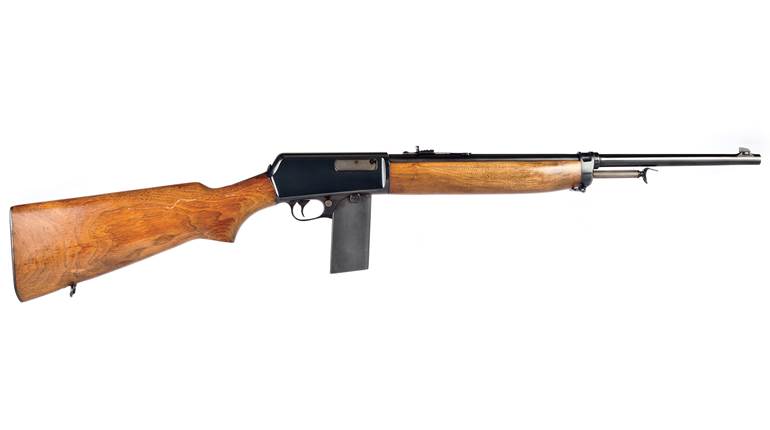
The gas system of the Winchester Model 100 semi-automatic sporting rifle is similar to that of the M14 rifle. This was pointed out by Winchester when the Model 100 was announced in 1960.—E.H. Harrison
Most Popular