** When you buy products through the links on our site, we may earn a commission that supports NRA's mission to protect, preserve and defend the Second Amendment. **
American Rifleman TV is in Wixom, Mi., at the home of Trijicon Inc., detailing the Advanced Combat Optical Gunsight. Watch the above video for details.

Little did he know, prior to 1981, that his “side job” of peddling gun sights would lead to a revolutionary concept with more than one million units sold. Millions of Americans, home defenders, peace officers and Soldiers have chosen to rely on Glyn Bindon’s Advanced Combat Optical Gunsight (ACOG).

The marvel behind the ACOG design is the Bindon Aiming Concept (BAC) that enables its users to maintain target focus without loss of peripheral vision by allowing both eyes to remain open. The addition of a brilliant aiming point comprised of Tritium and fiber optics further set Trijicon’s ACOG into its own class.

The battery-free ACOG is a U.S.-made, fixed-magnification optic built from forged aluminum. Trijicon supplies premium glass within its ACOG and each unit is hand-fitted and tuned for function and reliability. The advantage to this combat optic is the use of radioactive isotopes that yields a radio-luminescent light source. The easy-to-use optic has been a complete game-changer for the U.S. Military as its Rifle Combat Optic.

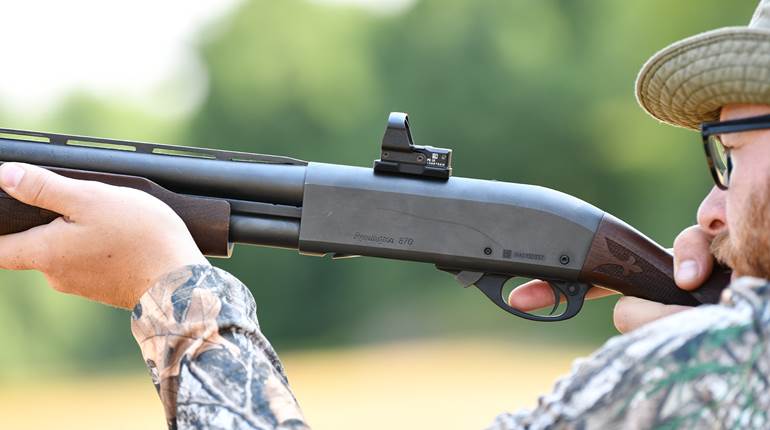
As years advanced for Trijicon and its ACOG, line extensions came to market with magnification enhancements and the inclusion of battery-powered LED aiming. Furthermore, Trijicon branched off into manufacturing reflex sights intended for close-quarter engagement that eventually found place on military and police handguns, too.

The RMR is reflex sight built of aluminum with a specialized and patented housing shape to increase the durability of the small optic—it isn’t always about the looks. Whether battery or Tritium powered, Trijicon’s RMR features true-color, multi-coated lenses and an aiming dot that is easily adjustable and provides the shooter with increased target focus while improving accuracy.

Two optic lines wasn’t enough for Glyn Bindon and his team at Trijicon. The company has expanded and demonstrated its ability to engineer products that resonate with armed citizens, military personnel, police, hunters, long-range shooters, archers and hobbyists. Follow along with the American Rifleman TV crew for a behind-the-scenes glance at the manufacturing and legacy of Trijicon.
Little did he know, prior to 1981, that his “side job” of peddling gun sights would lead to a revolutionary concept with more than one million units sold. Millions of Americans, home defenders, peace officers and Soldiers have chosen to rely on Glyn Bindon’s Advanced Combat Optical Gunsight (ACOG).
The marvel behind the ACOG design is the Bindon Aiming Concept (BAC) that enables its users to maintain target focus without loss of peripheral vision by allowing both eyes to remain open. The addition of a brilliant aiming point comprised of Tritium and fiber optics further set Trijicon’s ACOG into its own class.
The battery-free ACOG is a U.S.-made, fixed-magnification optic built from forged aluminum. Trijicon supplies premium glass within its ACOG and each unit is hand-fitted and tuned for function and reliability. The advantage to this combat optic is the use of radioactive isotopes that yields a radio-luminescent light source. The easy-to-use optic has been a complete game-changer for the U.S. Military as its Rifle Combat Optic.
As years advanced for Trijicon and its ACOG, line extensions came to market with magnification enhancements and the inclusion of battery-powered LED aiming. Furthermore, Trijicon branched off into manufacturing reflex sights intended for close-quarter engagement that eventually found place on military and police handguns, too.
The RMR is reflex sight built of aluminum with a specialized and patented housing shape to increase the durability of the small optic—it isn’t always about the looks. Whether battery or Tritium powered, Trijicon’s RMR features true-color, multi-coated lenses and an aiming dot that is easily adjustable and provides the shooter with increased target focus while improving accuracy.
Two optic lines wasn’t enough for Glyn Bindon and his team at Trijicon. The company has expanded and demonstrated its ability to engineer products that resonate with armed citizens, military personnel, police, hunters, long-range shooters, archers and hobbyists. Follow along with the American Rifleman TV crew for a behind-the-scenes glance at the manufacturing and legacy of Trijicon.