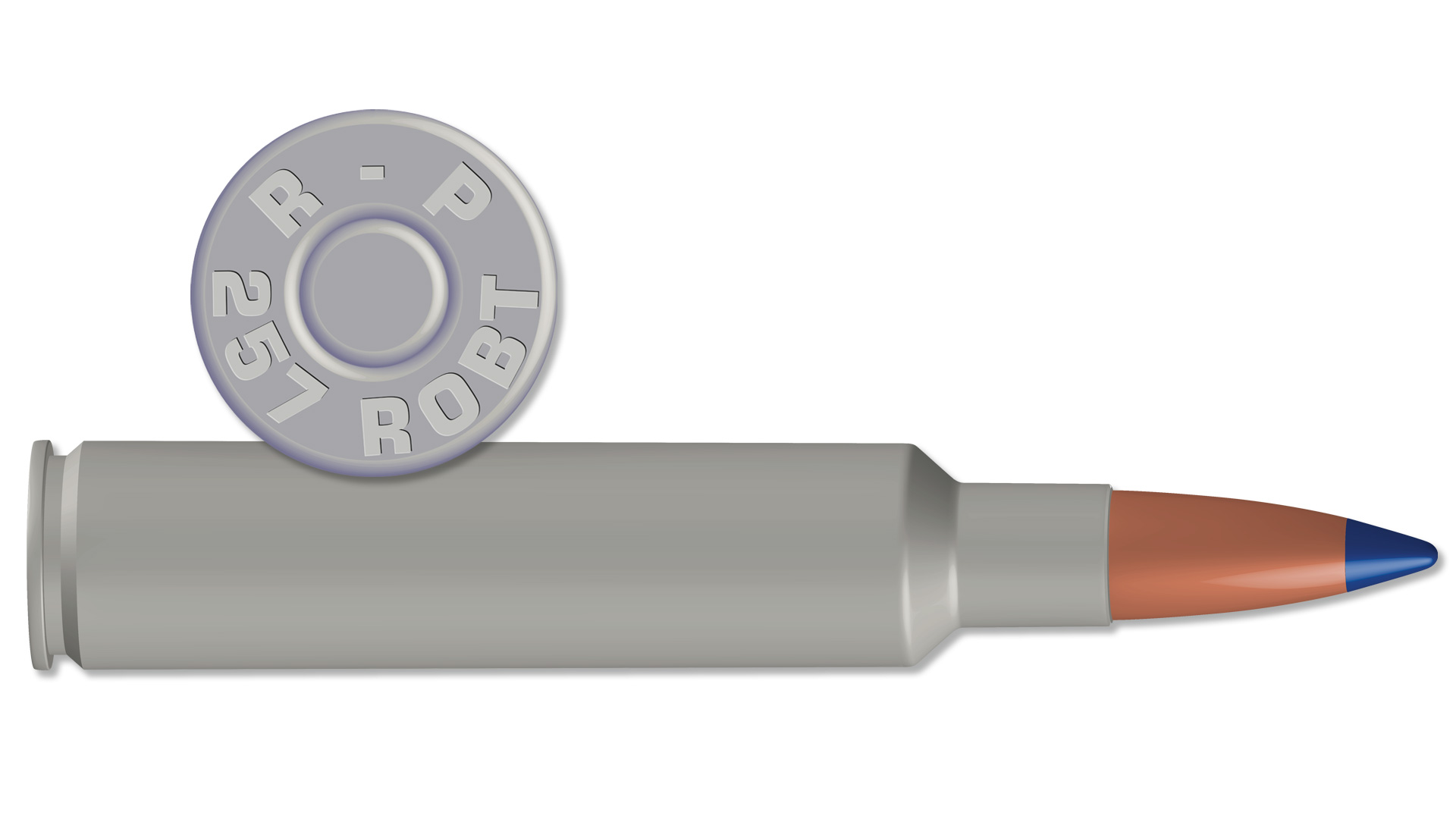
In his Handbook For Shooters And Reloaders (Volume 1), P.O. Ackley wrote of the .257 Ackley Improved that, “It is a relatively efficient cartridge, flexible and comes close to the mythical ‘all around cartridge.’”
 To make .257 Ack. Imp. cases requires fire-forming .257 Roberts cases in an Ackley Improved chamber; cases come out of the Improved chamber with a reduced body taper and increased shoulder angle. Be careful of this approach, though, as there are no established chamber dimensions for the .257 Ack. Imp. To fire-form empty Roberts cases, I loaded them with 10.0 grains of Bullseye powder—cases tamped full of Puff-Lon ballistic filler and a dab of glue on the case mouth to hold everything in place—and then fired them in my rifle’s Improved chamber. This method resulted in cases with 0.026" less case body taper, the body lengthened by 0.075" and the shoulder angle increased to 40 degrees. Fire-forming cases also shortened them in length a few thousands of an inch, but after four reloads, they still have not required trimming.
The Improved shape results in about a 7 percent total case capacity increase compared to the Roberts. Comparing my handloading records and loads from a couple of handloading manuals for both cartridges, .257 Ack. Imp. burns 12 percent to 17 percent more propellant than the Roberts to achieve 4 percent to 7 percent higher velocities.
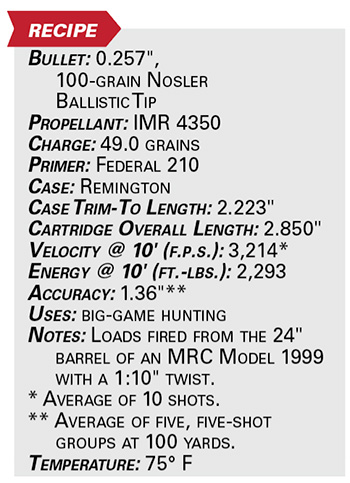
Trustworthy load data is rather limited for the .257 Ack. Imp. The Nosler Reloading Guide 9, though, contains plenty of reliable information. Both H4895 and Reloder 15 perform well shooting bullets weighing up to 80 grains, and H4831, IMR 4350 and 4831 and Reloder 22 are excellent paired with heavier bullets. The recipe’s load of 49.0 grains of IMR 4350 fired Nosler 100-grain Ballistic Tips at 3,214 f.p.s. from the Montana Rifle Co.’s 24" barrel. That’s about a 200 f.p.s. increase above what the .257 Roberts will fire the same weight bullet—which makes forming Improved cases well worth the toil.
Most Popular