The AR-15 rifle is wildly popular for many reasons: accuracy, modularity, magazine capacity and an ergonomic design that cannot be beat. For those of a certain bent, however, the venerable 5.56 NATO cartridge has always left us cold. Fortunately, Eugene Stoner’s original AR-10 was designed for 7.62 NATO (.308 caliber), so the platform can handle considerable pressures. A flood of new chamberings over the past two decades has forever altered the AR power equation, depending upon one’s preferences and tolerance for recoil.
Being a huge fan of Mikhail Kalashnikov’s 7.62x39 mm AK-47 cartridge, I always dreamed of combining the two into my ideal AR-platform rifle. Before 2010, this proved daunting for several reasons. With comparatively less pressure than the 5.56 NATO (around 45,000 vs. 55,000 p.s.i.), cycling the 7.62x39 mm round in an AR-15 can be problematic, to say the least. Reliable 30-round magazines didn’t exist back then either, making jams common. Spoiled AK fans will also appreciate my visceral dislike for direct-impingement operation, which channels fouling straight back into the finicky AR-15 bolt carrier.
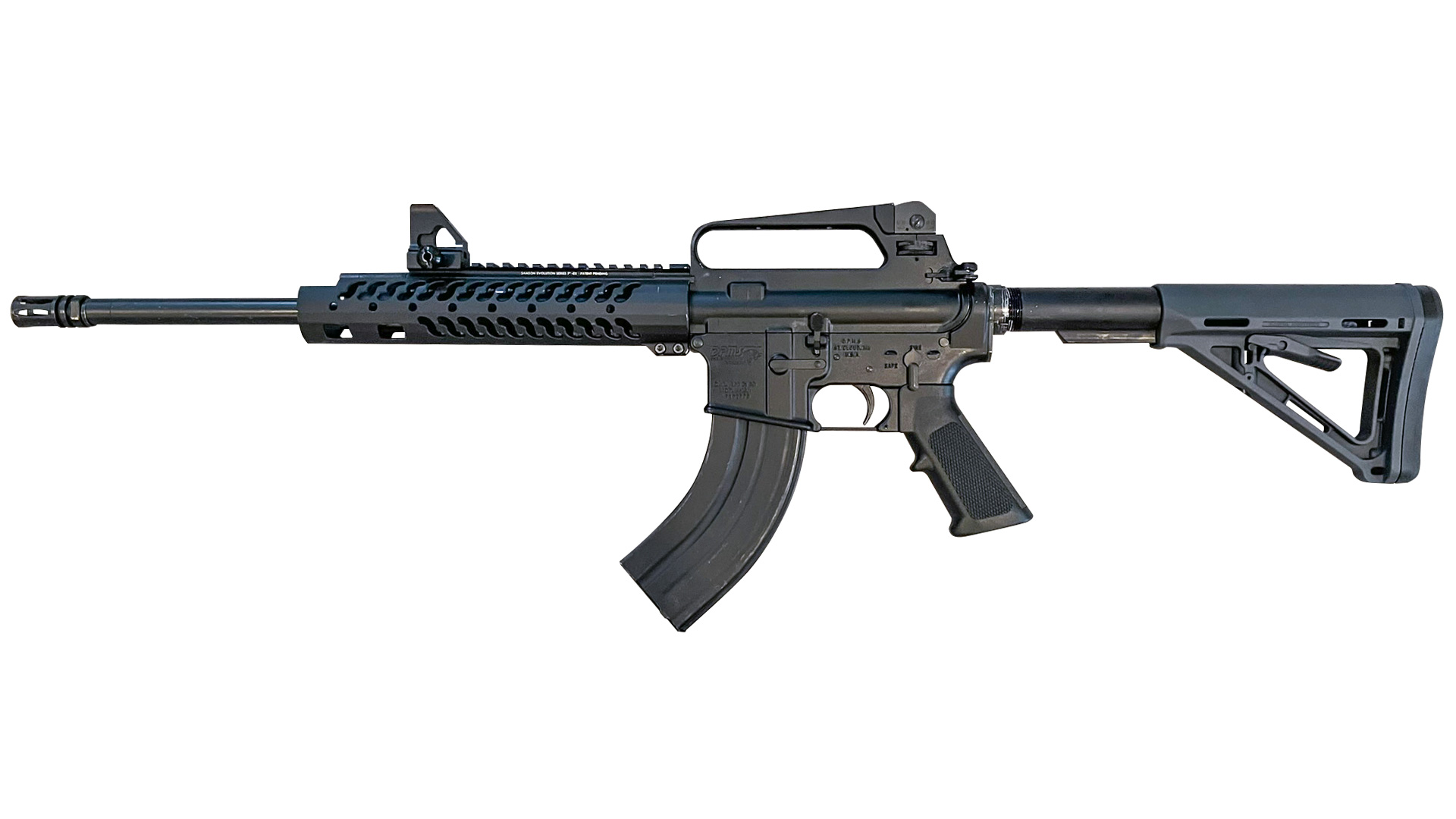
In February 2008, I finally bit the bullet, so to speak, purchasing a DPMS Arms AR-15 in 7.62x39 mm. Needless to say, the rifle suffered from all of the above shortcomings. But I already knew that going in: Far from a trustworthy defensive arm, the DPMS started out as a fickle work in progress that I proceeded to rebuild from the inside out.
First was an Adams Arms adjustable block piston and Samson handguard, eliminating my fouling problem. However, even at full throttle, brass 7.62x39 mm ammunition still would not cycle reliably. So, next came a low-friction Wolff recoil spring combined with a split buffer (two 1.5-oz. stock buffers instead of one 3 oz.), cutting resistance in half. Last, but not least, dependable magazines from DuraMag and other manufacturers became widely available around 2015 or so, lending my AR its customary 30-round firepower. Suddenly, my wildcat hobby-project DPMS was a 100-percent-reliable, hard-hitting tack-driver. I now consider it to be the finest firearm I’ve ever owned.
Moral of the story? All that fun and effort finally paid off. Come the zombie apocalypse, what started as a recreational labor of love will now be my very first tool in hand.
—Marc Edelstein
Most Popular