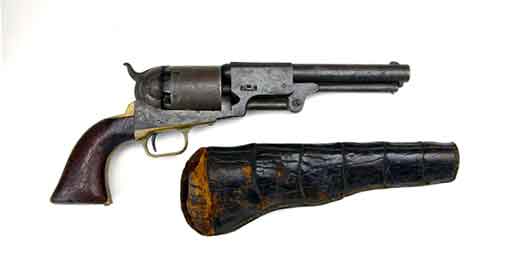
Gun: Colt 1851 Third Model Dragoon
Caliber: .44 percussion cap and ball
Serial No: 108XX
Manufactured: 1851 (first year production for Third Model)
Condition: NRA Fair (Antique Gun Standards)
Value: $4,500-$5,500 (with an additional $300 to $350 for the original unmarked alligator holster)
Until the advent of the .357 Mag., the .44-cal. 1847 Colt Walker was the United States’ most powerful revolver. Still, the handgun had drawbacks, most notably its massive size. In those early years of metallurgy, with increased firepower came greater bulk, and the Walker weighed a hefty 4 lbs., 8 ozs. In addition, its stout recoil often caused the loading lever to drop and plunge the rammer into the cylinder’s chamber, preventing it from rotating. Samuel Colt knew he had to make changes to keep his company afloat.
The result was the First Model Dragoon in 1848, which tipped the scales at 4 lbs., 2 ozs., with a slightly scaled-down frame and .44-cal. cylinder, an improved loading lever latch, and a 7½" barrel, which was shortened from the Walker’s 9"-long tube. The handsome Dragoon sported a brass backstrap and trigger guard (silver plated on civilian models), case hardened frame, loading lever and hammer, and one-piece walnut stocks. Military guns were stamped “U.S.” on the frame, and “WAT” on the stocks, for Ordnance Inspector W.A. Thornton. The cylinder provided ample space for W.L. Ormsby’s engraving of mounted riflemen in pursuit of Comanches.
The first 300 Dragoons featured some Walker parts, creating a sub-variation described by John Fluck in the September 1956 issue of American Rifleman. The First Model exhibited other Walker holdovers as well, including: a square-back trigger guard, oval cylinder locking holes, and “V” mainspring. The Second Model Dragoon, introduced in 1850, was designed with rectangular cylinder locking notches with lead-in grooves, and a flat mainspring.
But it was the Third Model Dragoon, produced from 1851 to 1861, with 10,500 guns made, that was the apex of the horse pistol. Produced in two barrel lengths, 7½" and 8", it featured an improved lever latch and rounded trigger guard. Besides extensive use during the Civil War, these guns were pivotal in the opening of the American West.
This Third Model, pitted and roughly cleaned, is in NRA Fair Condition with less than 10 percent of its finish remaining. The worn stocks exhibit shrinkage, with a chip off the left toe. The cylinder engraving and matching numbers are legible but worn. The trigger guard is slightly bent and there is a small crack on the right side of the frame, indicating forging problems. Interestingly, this gun came with an alligator holster, hinting of possible Southern origin. In spite of its condition, collector demand for these imposing pistols puts its value at $4,500 to $5,500.
Most Popular