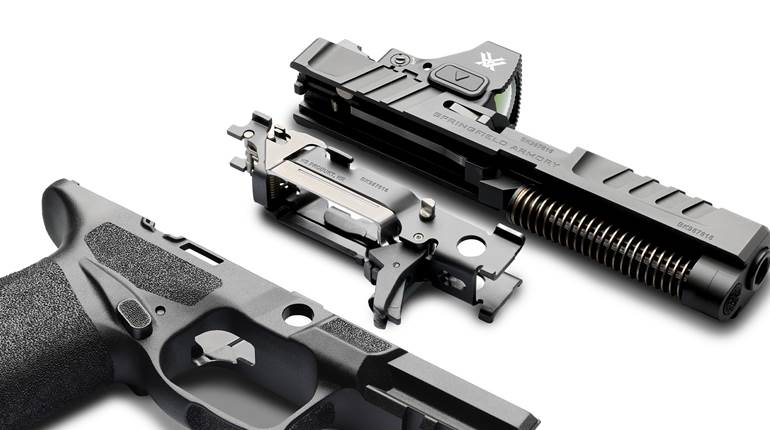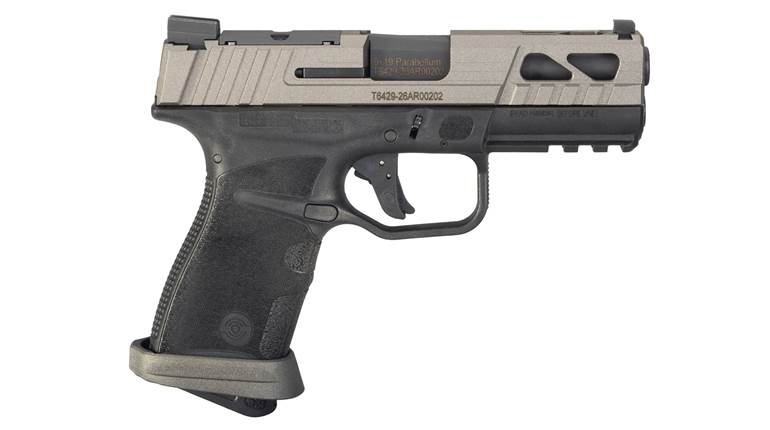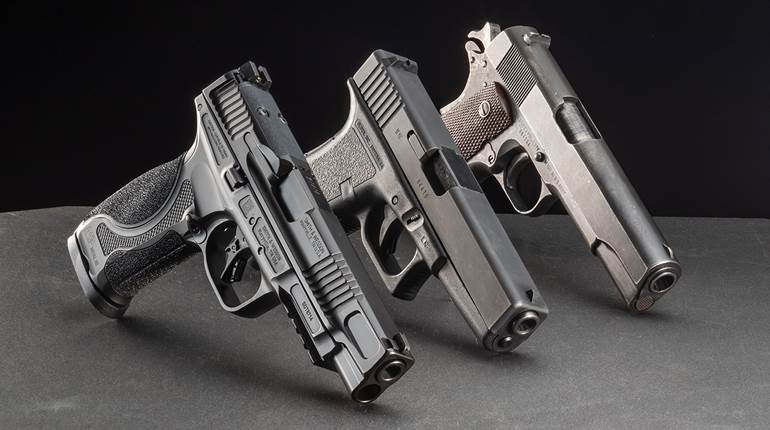
I recently had the pleasure of writing up the new SIG Sauer P320 for American Rifleman. Somehow or another, I left a number of readers a little confused about the pistol's trigger action, and we can't have that. So let's take a quick second look at the gun and see if we can get things straightened out. 320s are striker-fired pistols, a first for SIG Sauer. The striker is spring loaded and becomes fully cocked when the slide comes all the way to the rear, either manually or when the act of firing drives it back. To fire, the shooter presses the trigger, an act that clears safeties and releases the striker. This initial trigger pull does feel a great deal like several other guns (Glock, S&W M&P) that partially pre-cock the striker and are called DAOs (for double-action-only). 
But the correct technical definition of DAO is a system where trigger pressure performs the twin functions of cocking and firing. Since the P320 is already cocked, the trigger can only release the striker. It would have to be more like an SAO (single-action-only) trigger. It would probably be better to say that DA and SA are terms that define trigger action as it relates to the pistol's lockwork. Leave the clearing of passive safeties out of the equation, even though they make some of these trigger systems feel very DA-like. Somehow, the term DAO has come to be associated with greater safety in handling, so it is unlikely that the makers will cease using it on guns that are clearly fully cocked. 
It is also interesting to note that proper use of the reset point in the trigger can be so very useful. For the first shot in a series, the shooter has to sweep the trigger through a longer arc to get it in position to make that important release of the striker and fire. With practice, after firing the shot, he learns to allow the trigger to return only the short distance to where it resets the striker for firing. If he needs a second shot, he now moves the trigger back the same distance and it fires again. Like the old joke, repeat if necessary. There is usually a major difference in the length of trigger travel from all the way down to trigger travel from reset.
I hope this helps, but I am betting we haven't heard the end of the subject.
Most Popular