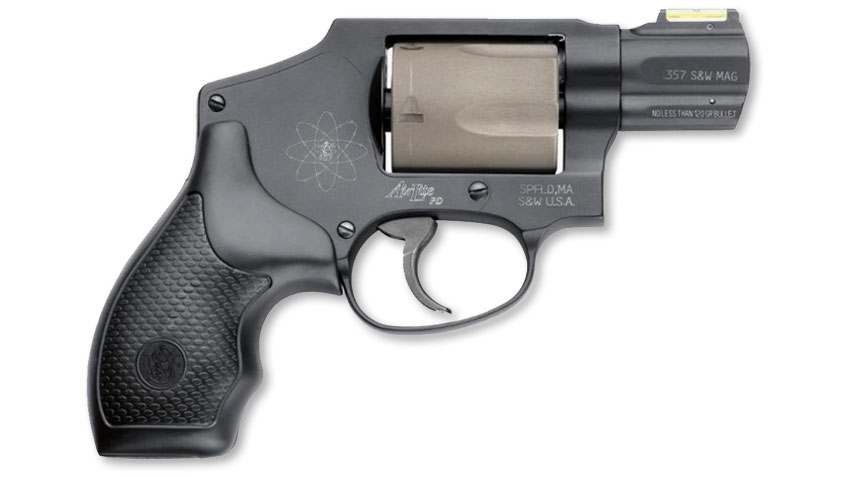
The revolver is in decline as a commonly used defensive firearm. New revolver models trickle onto the market, where there was once a flood. Although Kimber now offers a revolver—in the most useful wheelgun format—this style of handgun just does not grab the attention of handgunners as it once did. I sense no vile conspiracy against Sam Colt's invention, but simply a fickle market and ahh, progress. New semi-automatics abound and some of them manage to squeeze a round or two more into an auto that is easier to hide than a comparable revolver—it goes on and on. Naturally, since I personally lament the decline of a gun that I used for so long, I am always willing to issue forth with reason(s) why this should not happen.
There are more different kinds of people regularly using handguns in daily work than ever before. That means there are more people with small hands, who have problems managing an auto that has its ammo supply in the butt. Aside from slimming the grip panels a bit, there is very little a person can do to modify a gun for small hands. Many—probably most—modern semi-automatics don't even have grip panels because the butt is shaped out of polymer and grips are not required. Some handgunners who prefer a semi-automatic choose one that is sized to fit comfortably, but is chambered for a shorter cartridge that is marginal in the performance sense.
Most revolvers have removable grips that come off with a single screw. It is a fairly easy matter to replace them with grips that are thicker or thinner. There is always the possibility of changing the shape of a revolver's butt by using custom grips. Such things as finger grooves, filler blocks (behind the trigger guard) and extended bottoms are all possible with replacement grips. In the revolver age, various firms made wood—sometimes rubber, plastic or horn—grips for all the common models. For a majority of shooters they worked quite well. Competition shooters like the thumbrests and finger grooves, while combat revolvermen needed something ambidextrous. The point is that it was a lot easier to deliver that feature on a revolver than an auto.
Most Popular