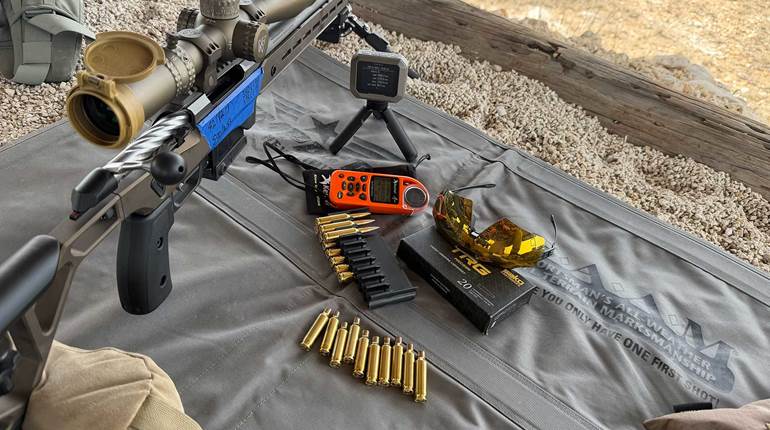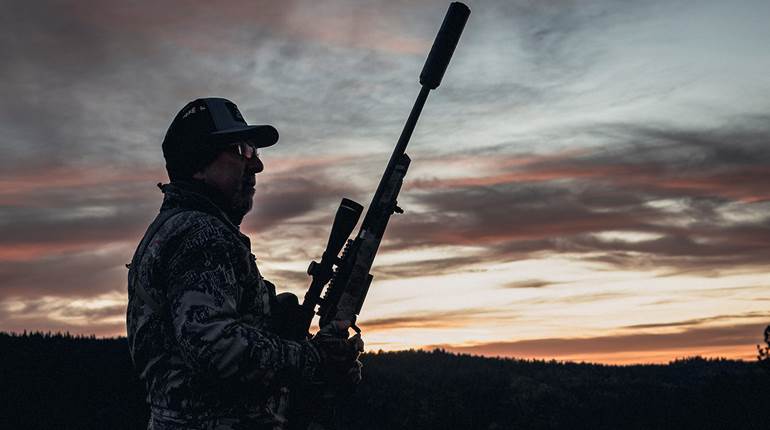
After three days of training and shooting, Day 4 of FTW Ranch's SAAM Precision course (Sportsmans All-Weather All-Terrain Marksmanship) culminates with a practical evaluation and a chance for students to apply what they've learned. The instructors call it a "drive around," and essentially it is an eight- to 10-station course that includes shooting positions and distant targets at points all across the ranch's 12,000 acres.
It's a bit like golf, but with guns. Three- and four-person groups were assigned lanes and, with an instructor/score keeper, began driving from "hole" to "hole". At each shooting position a target was identified and engaged by the students. Shooters had three shots with which to engage each target, and point values were assigned for first-, second- and third-round hits. Obviously a successful first shot was worth more points than a third-shot save. For my group, targets ranged from about 450 yds. to 800 yds. Our instructor also served as a spotter (caddy?) and provided one wind call for each shooter-the call was in miles-per-hour, so shooters had to confirm the call, multiply for distance-to-target, and choose their own holds. The real challenge, and test of our marksmanship, came in determining wind holds and, on unsuccessful shots, observing impacts and making appropriate adjustments to score a follow-on hit.
My colleagues here in the Rifleman offices will be relieved to know that I came out on top in my heat. But the margin of victory was only one point (of 50 possible), and the spread for my four-person group was only two points. I think this is a real testament to the training and instructors at FTW. Everyone who attended the course was a better rifleman (or woman) by the end, and the skill-level gap between relatively new shooters and those with more experience shrank to almost nil. I think that alone qualifies everyone as a winner, and serves as a ringing endorsement for FTW's SAAM Precision training.