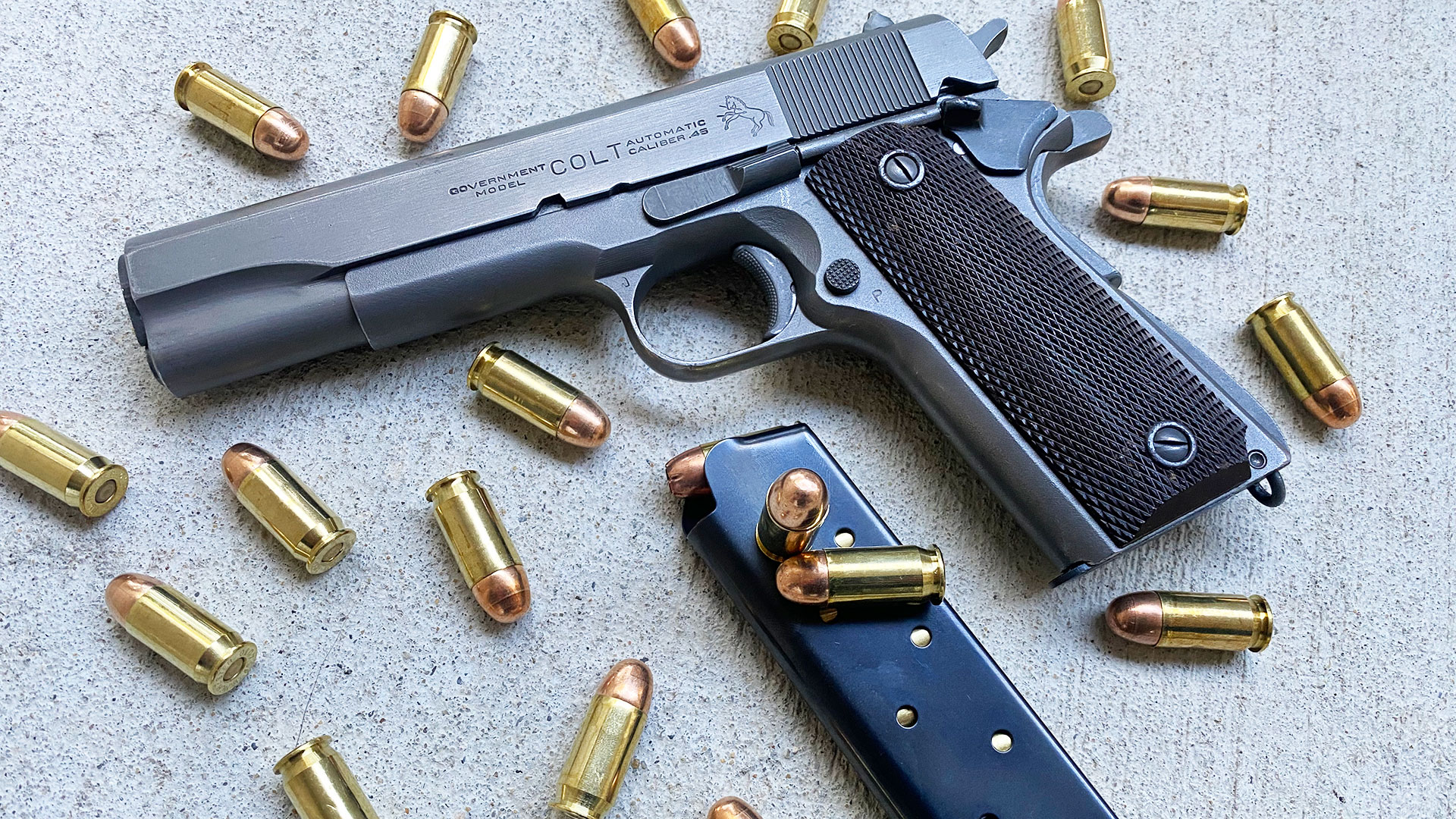
Remington's recent decision to offer the public a 1911 style .45 pistol is well timed. Back in March, we passed the 99th anniversary of the official adoption of the M1911 pistol as the sidearm of the U.S. Army. Next year, we'll see the centennial of that great old classic. For a host of reasons, the 1911 is an enduring firearm. I have yet to handle a sample of the Remington version, but it looks good and the early reviews of the gun by other writers are favorable.
Most shooters are aware that a lineal predecessor of today's Remington arms company—Remington UMC—made 1911s in the World War I era and Remington Rand (an unrelated company) made them during World War II. However, it has been many years since Big Green had anything to do with handguns, so the new 1911 pistol requires completely new set-up, tooling, etc. I am confident that they will handle the project very well—after all, they have been making guns of all types for almost 200 years.
The association of the terms “Remington” and “.45” sends my mind racing back to another gun that embodied both those words, but ended up little more than a footnote in gun history. The gun was another automatic pistol, but there is no connection (and only passing resemblance) to the Colt-Browning gun that made so much history. Remington produced only prototypes of a pistol called the Model 53. In the immediate post-WWI period, the Navy and Marine Corps were having some problems getting enough M1911 style autos and began to explore options of their own. This type of arms procurement may seem unusual in today's Department of Defense atmosphere, but it was done in 1919-1920. A full-sized service auto with single action trigger and single column magazine, the Model 53 was developed exclusively for a possible contract with the U.S. Navy. Designed by John Pedersen, the new .45 was based on his Model 51 pocket auto in .32 ACP and .380 ACP.
Even today, there are serious shooters who place great stock in the slim little Remington Model 51. It is an exceptionally pocketable auto. Designer Pedersen is said to have spent a great deal of time building models, which were tried by everyone in the Remington plant. Pedersen wanted the best possible ergonomics for the greatest number of people and he worked hard to get it. I found and used a 51 when I was a police officer many years ago. Eventually, I put it away, but only because of the limited power of the .380 cartridge and not any lack of satisfaction with the gun. Remington's advertising slogan for the pistol was: “Fits your palm like the hand of a friend.” That was as true a statement as was ever used in advertising. From the shooter's perspective, the Model 51 shape pointed better than anything else in use. Better yet, the bore axis was closer to the hand than any other auto I have ever tried. That's why I am intrigued with the possibility of a scaled-up version of the gun in .45. That would be the pistol that was evaluated by the Navy in 1920, but not adopted and never put into serial production. As far as I know, there were only prototypes of the pistol made, but looking at their pictures suggests a very graceful gun that I would love to shoot.
Most Popular