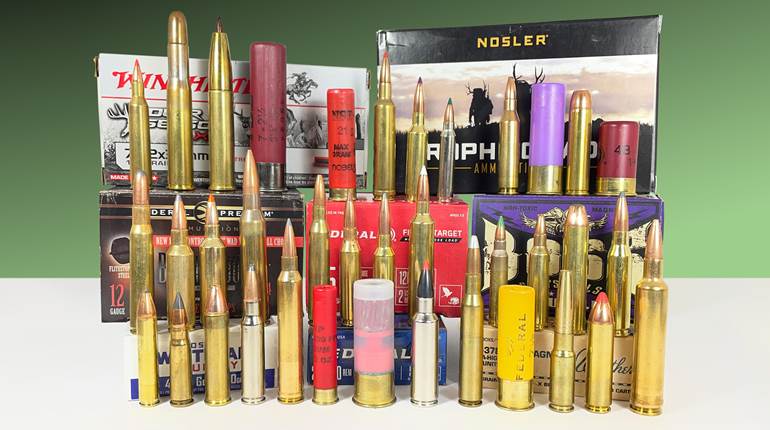
Q: I see ammunition listed all sorts of ways—.22 cal., .223 Rem., .44-40, 32-30, .38-40, 7.62 mm NATO, .30-’06 Gov’t, .25-3000, etc. Can someone please explain rifle ammunition nomenclature. What do the numbers mean?
A: You are certainly not alone in this situation, and I don’t think it does our discipline/hobby/sport any good, especially in drawing new associates into the fold. While there is a certain pattern in cartridge designations, it reminds me of attempting to learn a new language or breaking a code, and, unfortunately, not all of our members seem willing or able to help in the tutoring. The same sort of thing exists in European and Asian automobile alpha-numeric coding.
As there is really no way to succinctly explain all of the various designations here, I’ll try to hit a few high points. Please keep in mind that some effort may be required to research an “illogical” designation in order to determine its origin. If this truly interests you, I would recommend securing a copy of Cartridges Of The World, in its latest edition, originally by Frank Barnes. It is continually updated. Another source is the Sporting Arms and Ammunition Manufacturers Institute (SAAMI) website (saami.org), which will provide dimensional specifications.
Most cartridge designations will include some sort of numeric indication of nominal internal bore dimensions represented in hundredths or thousandths of an inch. Examples are: .22 Long Rifle, .22 WMR, .22 Hornet, .220 Swift, .22-250 Rem., .225 Win., .218 Bee, .219 Zipper, .224 Weatherby, .222 Remington, .22 Jet, etc. You will need to take my word for it that all these examples feature bullets of nearly the same size, albeit with a few exceptions. Some are named for the company that introduced them. The .22-250 was formed from a .25-cal. cartridge necked-down to .22 cal. The Hornet, Bee and Wasp were named at the whim of the developer.
Early on in cartridge development, when blackpowder was the only propellant, a two-number system worked reasonably well—the first number being the bore size, the second number being the amount of powder in grains, such as .50-70, .45-70, .44-40, .32-20 or .40-82. But then different manufacturers “developed” their own version that might be somewhat different than the rest. There exists both a .40-70 Sharps (straight) and a .40-70 Sharps (necked). You mentioned the .38-40; it’s actually a .40-40, sharing the same bore size as the .41 Long Colt. But once smokeless powder became a reality, this system crashed.
The “06” of .30-’06 Sprg. indicates a date (1906), and was derived from the earlier .30-’03. The “3000” of .25-3000 stands for 3000 f.p.s. Creedmoor was the name of a range. We haven’t yet discussed European metric designations (caliber by case length in millimeters), and proprietary cartridges offer yet another layer of confusion.
Most Popular