Rollin White’s 1855 patent for a bored-through cylinder was not just clever in its own right, it was also responsible for other inventors coming up with unique designs to try and circumvent it.
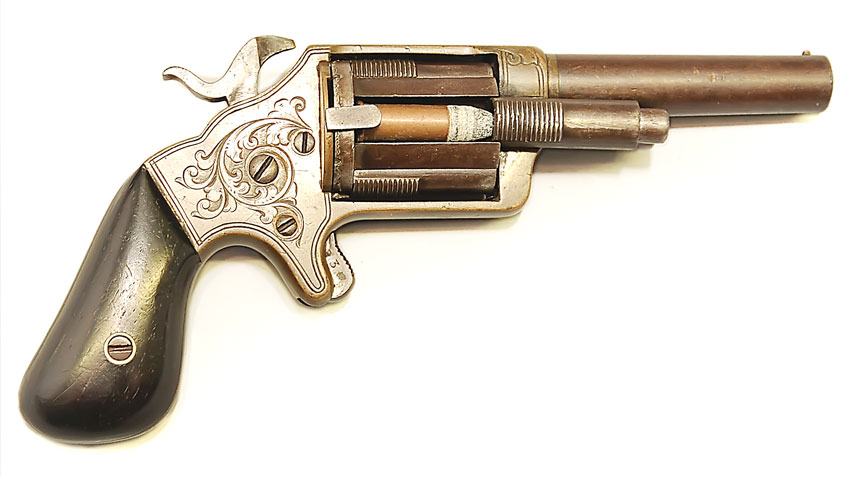
One of the more successful attempts involved an ingenious “improvement in revolving firearms” patented by Frank P. Slocum of Brooklyn, N.Y., on April 14, 1863. To skirt White’s method of inserting cartridges through the rear of a cylinder, Slocum devised a system whereby rounds were inserted into the sides of the chambers.
This was accomplished by first putting the revolver on half-cock and then turning the cylinder to a position whereby a chamber aligned with a plunger on the right, front of the frame. It was now possible, after moving a small lever at the rear of the cylinder, to slide separate covers forward onto the post. This revealed the chambers and allowed five rounds (in this case the readily available .32 rimfire used in the popular Smith & Wesson No. 2 revolver) to be individually loaded. In turn, the covers were returned to their original positions and the gun was ready to fire. Removal of spent cases was achieved in a similar manner.

The single-action Slocum revolvers were manufactured by the Brooklyn Arms Co. of Brooklyn, N.Y., in 1863 and 1864. There were three variations, including one small-frame in .22 Short, all of which were rather diminutive—the .32s were some 6½" overall with a 3" barrel. The most common version, seen here, had a scroll-engraved, silver-plated brass frame, blued barrel and cylinder, casehardened hammer, spur trigger and two-piece, bag-shaped rosewood stocks. Sighting was rudimentary, involving a simple bead at the front and a groove in the topstrap in the rear. Fully plated versions were also available on special order.
Slocums were sold in cardboard boxes—an original box is a rare find today. They were aggressively marketed, the maker offering such claims as “It can be Loaded in the Dark” and “It can be Carried in the Pocket with Safety when Loaded.” Apparently, the pistol and the hype worked well enough, because in a scant year-and-a-half or so, some 10,000 were manufactured and sold. I have actually fired the revolver shown here and can attest to its practicality and reliability. One wonders why this interesting little repeater did not achieve a more lasting success—though competition with not only Smith & Wesson, but other makers of early cartridge revolvers, such as Moore, Plant and Pond, probably diluted a saturated field.
This month’s “Old Gun” is in excellent mechanical condition and retains at least 40 percent of the original silver-plated finish. The bluing, for the most part, has turned a brownish patina, but markings are sharp, and it still can confidently be rated as “NRA Fine.” It’s worth $875.
Gun: Slocum “Side-Loading” Revolver
Manufacturer: Brooklyn Arms Co.
Chambering: .32 rimfire
Manufactured: c. 1863-1864
Condition: NRA Fine (Antique Gun Standards)
Value: $875
Most Popular