by
Support NRA American Rifleman
DONATE
** When you buy products through the links on our site, we may earn a commission that supports NRA's mission to protect, preserve and defend the Second Amendment. **
 One of the most produced firearms of World War II was the British Sten Mk II machine carbine. While the Americans called the Thompson and M3 “grease gun” submachine guns, the British settled on the term “machine carbine,” so we will use it here. More than 4 million Sten guns were made during World War II, with the most common version being the Mk II. Invented by Harold Turpin and Major Reginald Shepherd, you combine their initials with the first two letters of Enfield (Royal Small Arms Factory Enfield), and you get S-T-E-N.
The Sten was a simple blowback-operated submachine gun that fired from an open bolt, and it was fed by a 32-round detachable box magazine from the left side. Derisively, it has been called “Mr. Woolworth’s gun” or the “stench gun,” but I disagree. Frankly, most problems with Stens originate with the magazine’s feed lips. If you have a good magazine and keep the gun relatively clean, you will have no problems with the Sten. If you have a bad magazine, or one with bent feed lips, you will have issues.
One of the most produced firearms of World War II was the British Sten Mk II machine carbine. While the Americans called the Thompson and M3 “grease gun” submachine guns, the British settled on the term “machine carbine,” so we will use it here. More than 4 million Sten guns were made during World War II, with the most common version being the Mk II. Invented by Harold Turpin and Major Reginald Shepherd, you combine their initials with the first two letters of Enfield (Royal Small Arms Factory Enfield), and you get S-T-E-N.
The Sten was a simple blowback-operated submachine gun that fired from an open bolt, and it was fed by a 32-round detachable box magazine from the left side. Derisively, it has been called “Mr. Woolworth’s gun” or the “stench gun,” but I disagree. Frankly, most problems with Stens originate with the magazine’s feed lips. If you have a good magazine and keep the gun relatively clean, you will have no problems with the Sten. If you have a bad magazine, or one with bent feed lips, you will have issues.

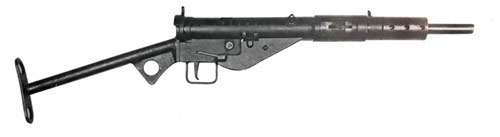
The Sten Mk II was a simplified version of the earlier Mark I and Mk I *. The Mark II had a simple barrel nut that secure the 7 ¾” barrel to the receiver. By pulling a catch at the front of the magazine housing, you could rotate the entire assembly to cover the action port to keep debris out of the gun or to make transport easier. Unlike the Mark III, of which about 1 million were made by the Lines Bros. toy company, you could replace the barrel on the Mk II if need be. For the Mk III, if you shot the barrel out or had another issue, you just had to throw it away. And that’s OK because the cost to his Majesty‘s government per gun was about $10. Capable of about 550 rounds per minute, the Sten could also be set to semi-automatic only via a button in the housing under the receiver. It lacked a proper safety, with a notch cut above the slot for the reciprocating both handle’s travel holding said bolt handle in the rearmost position.

Winston Churchill firing a Sten Mk II
 The Sten was a marvel of manufacture. Hundreds of subcontractors made the small bits necessary to produce to gun, allowing crucial tooling at the Royal Small Arms Factory Enfield to be used to manufacture the vitally needed Bren gun. About the only parts that needed serious machinery to manufacture were the bolt and barrel. Most of the rest of the parts were stampings or could be made in a muffler shop.
I’ve shot every version of the Sten from the Mk I through the Mark V, and must say some of the nicest Stens are the Mk IIs made in Canada by Longbranch. You can tell and original Longbranch guns from their loop stocks as opposed to British T-shaped stocks. Fit and finish is the nicest of all Stens; as much as they wanted to, the Nazis were unable to bomb Ontario during World War II.
The Sten was a marvel of manufacture. Hundreds of subcontractors made the small bits necessary to produce to gun, allowing crucial tooling at the Royal Small Arms Factory Enfield to be used to manufacture the vitally needed Bren gun. About the only parts that needed serious machinery to manufacture were the bolt and barrel. Most of the rest of the parts were stampings or could be made in a muffler shop.
I’ve shot every version of the Sten from the Mk I through the Mark V, and must say some of the nicest Stens are the Mk IIs made in Canada by Longbranch. You can tell and original Longbranch guns from their loop stocks as opposed to British T-shaped stocks. Fit and finish is the nicest of all Stens; as much as they wanted to, the Nazis were unable to bomb Ontario during World War II. 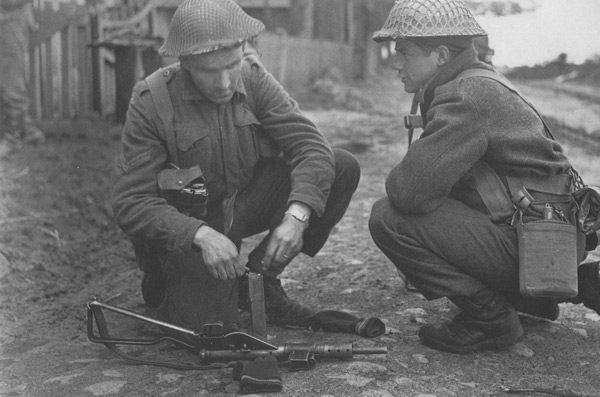
The Sten was the right gun at the right time to defend Great Britain from Hitler’s war machine, especially after much of the British army’s equipment was left on the beach of Dunkirk.
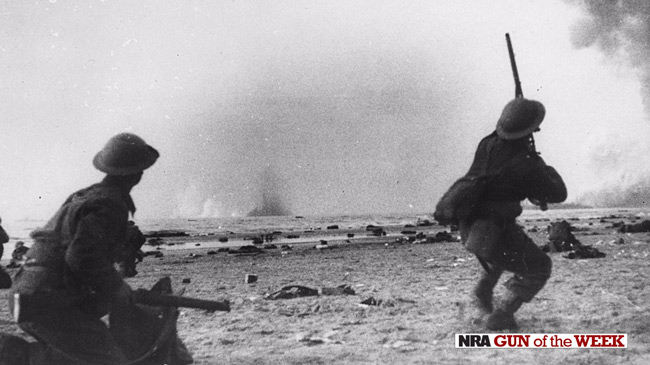 Wherever the British army fought, the Sten did its job (backed up by the Thompson in some units and theaters). There were variants made in Australia, the “AUSten,” and they were even copied by the Germans with the MP3008 at the end of the war. They could even be made by resistance workshops in occupied Europe, arming Frenchmen and Poles. The Sten, in particular the Mk II, remains one of the most important guns of World War II, having played a significant, if not low rent, role in the defeat of Nazi tyranny.
The Sten Machine Carbine
Sten Machine Carbine Mk II & Mk III
Action Type: direct-blowback, selective-fire machine carbine
Chambering: 9 mm Luger
Weight: 7 lbs.
Overall Length: 30”
Barrel length: 7.75”
Magazine: detachable box, 32-round capacity, staggered column (works with 30)
Cyclic Rate: 500 rounds per minute
Realistic Rate: 90 to 100 rounds per minute
Rifling: six-groove, RH twist
Bullet Weight: 125 grs.
Bullet Velocity: 1060 f.p.s.
Effective Range: 200 yds.
Maximum Range: 1,600 yds. (a bit optimistic)
*Manufacturers:
Singer Mfg Mk I, MK I*
BSA Gun Mk II
Lines Brothers Mk III
ROF Fazakerly Mk II, IIS, Mk V
ROF Theale Mk II, Mk IIS, Mk V, Mk VI
RSAF Enfield MK VI
Longbranch MK II
(*more than 300 parts subcontractors)
Total Produced: 4,184,237