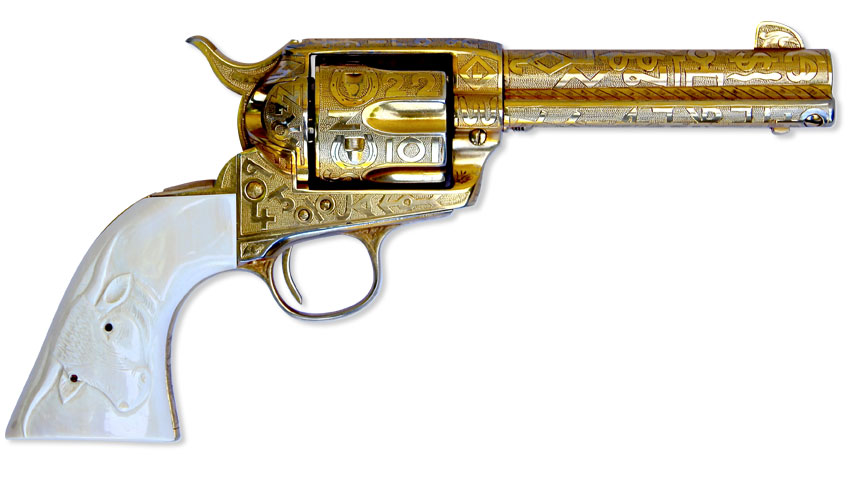
Q: I saw a unique Single Action Army at a gun show recently. It was gold-plated and completely engraved with cattle brands. All the owner of the gun could tell me was that it was a “cattle brand Colt.” Can you tell me about this type of engraving or its history?
A: Generally, a cattle brand Colt refers to a Single Action Army (SAA) that has been given full-coverage engraving that depicts a multitude of cattle brands, usually on a punch-dot background.
Full cattle brand coverage is also found on other types of firearms, including double-action revolvers and semi-automatics, as well as on shotguns and rifles. However, due to its western motif, it is primarily associated with single-action revolvers.
Cattle brand guns reportedly originated sometime during the 1930s with Texas engraver Cecil Coe “Cole” Agee (1901-1955). Although he also engraved guns with the more commonly seen scrollwork patterns, Cole Agee’s unique West Texas cattle brand designs were extremely popular with lawmen, western movie stars and collectors, and, due to their scarcity, are highly desirable today.
Unfortunately, it is not known how many cattle brand Colts Agee engraved (estimates range from as few as 15 to as many as 50), as he rarely signed his work. I know of only four Agee-engraved guns that have been authentically signed, two of which are shown in the late Jink Howard’s privately printed book, Cole Agee: Texas Engraver, and none of them “signed” in the same manner. However, as an identifiably distinctive style, Agee was known for often engraving the inside curve on the SAA grip strap, an area most engravers leave blank.
Naturally, all of Agee’s cattle brand SAAs are First Generation Colts, as Second Generation guns didn’t exist back then. Agee was not above substituting Christy barrels or cylinders on single-actions to be engraved, and was also known to change calibers. Many of Agee’s cattle brand guns were gold-, silver- or nickel-plated and often sported carved ivory steer-horn stocks.
Around 1950, Agee began teaching his cattle brand technique to another engraver, Weldon Bledsoe, who continued the cattle brand patterns after Agee’s death, creating approximately 300 to 400 First-, Second- and Third-Generation cattle brand Colt single-actions well into the 1980s (Agee is sometimes said to have used the “2 lazy 2 P” brand as his signature, but this is more often found on Bledsoe-engraved guns). Bledsoe, in turn, passed the technique on to David Wade Harris (dwharris.com), who, along with a number of other master engravers, carries on the cattle brand style that Cole Agee made famous.
--Rick Hacker
Most Popular