by
Support NRA American Rifleman
DONATE
** When you buy products through the links on our site, we may earn a commission that supports NRA's mission to protect, preserve and defend the Second Amendment. **

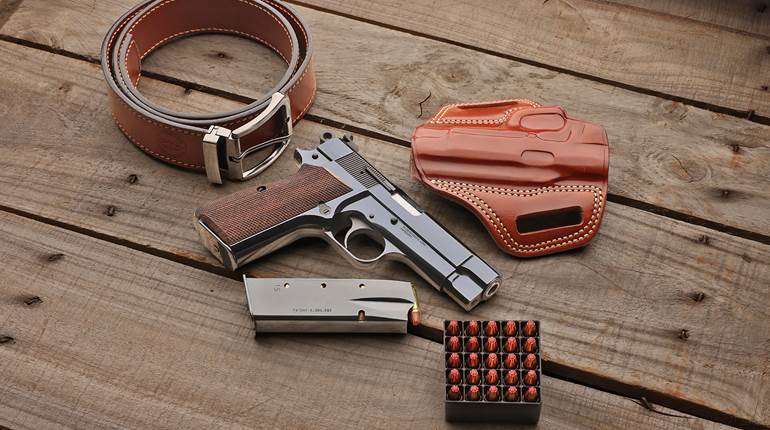
1. High Power or Hi-Power: If the gun is marked “Fabrique Nationale,” it is a High Power. If the gun is marked “Browning Arms Company,” than it is a Hi-Power. The Hi-Power nomenclature was introduced by Browning in the 1950s in order to avoid confusion with the Browning High-Power Rifle. The original pistol, as introduced in 1935, and all subsequent variants marked and sold by FN, were labeled High Power.

2. The black paint found on some High Power pistols originated from a French request in 1929-1930. This request was, ironically, not tied to the development of the High Power for the French military, which was ultimately never adopted. It was instead requested for the FN Model 1922 for use by the French Navy. FN developed a corrosion-resistant finish by applying black enamel paint over a phosphate base finish. This finish remained a standard for decades and was used on many military arms including the post-war High Power pistols, FAL, and FNC rifles and other models.
3. FN manufactured very few pre-war pistols with fixed sights. Asides from pre-war serial numbers, these can always easily be identified by the fact that the frames are always slotted for shoulder stocks.
4. Serial numbers and contract numbers: FN maintained serial numbers for commercial pistols, military and LE guns were typically made on order. If a customer requested it, guns were marked with contract numbers (example 1-500) instead of the standard serial number. Consequently, a low number does not necessarily indicate an early production pistol, it can be part of a contract run.
5. The red paint on the back of the pre-war and post-war grips is actually a moisture barrier applied to avoid absorption of humidity/water by the wooden grips. The red color was coincidental and had no specific significance. The practice was abandoned in the 1960s and modern grips are now often painted red in order to pass them as period originals.
2. The black paint found on some High Power pistols originated from a French request in 1929-1930. This request was, ironically, not tied to the development of the High Power for the French military, which was ultimately never adopted. It was instead requested for the FN Model 1922 for use by the French Navy. FN developed a corrosion-resistant finish by applying black enamel paint over a phosphate base finish. This finish remained a standard for decades and was used on many military arms including the post-war High Power pistols, FAL, and FNC rifles and other models.
3. FN manufactured very few pre-war pistols with fixed sights. Asides from pre-war serial numbers, these can always easily be identified by the fact that the frames are always slotted for shoulder stocks.
4. Serial numbers and contract numbers: FN maintained serial numbers for commercial pistols, military and LE guns were typically made on order. If a customer requested it, guns were marked with contract numbers (example 1-500) instead of the standard serial number. Consequently, a low number does not necessarily indicate an early production pistol, it can be part of a contract run.
5. The red paint on the back of the pre-war and post-war grips is actually a moisture barrier applied to avoid absorption of humidity/water by the wooden grips. The red color was coincidental and had no specific significance. The practice was abandoned in the 1960s and modern grips are now often painted red in order to pass them as period originals.
Most Popular