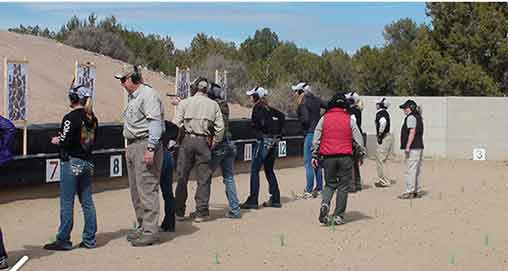
Attending a defensive shooting school can be expensive, but it is the best way to get on the fast track to learning the skills necessary to survive a violent criminal attack. Your instructors have the responsibility to provide you with the sort of training that will actually work in real life and to do it in a safe range environment. However, the student also has some responsibility if the class is to be truly successful and worth the money that is spent. Here are some ideas that might help you get ready for that next defensive-shooting class.
Get Your Gear In Good Shape
It can be very disappointing to have some of your gear fail right in the middle of the best class you have ever attended. It is a good idea to make sure that your guns are clean and in good repair. The same goes for your magazines if you are shooting an autoloading pistol. Give the same once-over to your holsters, ammo carriers and belt. Regardless, it is also a good idea to take an extra pistol-of the same type you are going to use in class-holster, belt and ammo carrier. It is amazing how even quality equipment will give up the ghost under heavy usage.
Your clothing should be comfortable and suitable for the existing weather conditions as well as heavy use on the firing range while you are running, kneeling and going prone in a hurry. Do I even need to tell you that a week-long shooting class is not the place to break in a new pair of boots?
Get Yourself In Good Shape
Few people realize the physical and mental stress that one experiences in a defensive shooting class. And when your body is tired and sore, you don't learn very well. I don't think you need to start bench-pressing 250 pounds or running 20 miles each day, but it sure wouldn't hurt to start doing some stretching exercises and walking on a regular basis. The better physical shape that you are in when a class starts, the better you will learn.
Park Your Ego at the Front Gate
You should be taking this defensive class to learn, not to show people how cool you are. The range master is probably not going to ask you to teach the class for him, even though you know that you could. You should be focused on learning as much as you can and enjoying the experience. You should also keep in mind that, if you are a bad shot the instructors have seen worse. And, if you are a good shot the instructors have seen better.
Make a Comittment to Do It Their Way
You may suddenly realize that this particular school doesn't do things the way your favorite gun writer or Internet guru thinks it ought to be done. The range master doesn't need to have that pointed out to him. The best idea is to do things their way for the duration of the class. Who knows? You might actually learn something new and useful. At home you can evaluate what you've learned and incorporate what works best for you.
The only exception to this is if you feel that you are being asked to do something that just doesn't seem safe. In that case, ask for an explanation. If the explanation doesn't satisfy you, go home.
Give 'Em a Break
Throughout each day's class, you will be given break time. This is time for you to load magazines, drink water, use the facilities and relax. Oddly enough, it is also time for the instructors to drink water, use the facilities and relax. Using the break time to tell war stories to the instructors-or even worse, telling them how you guys do it back home-is probably not a good idea. Your efforts along those lines will probably not even be appreciated.
Be the Kind of Student They Want to Invite Back
Make a commitment to listen and learn. Don't hesitate to pitch in and help stick up targets or pick up brass. Make yourself useful. Instructors really like a student who can keep his ears open, his mouth shut and a smile on his face.
Any successful school is a combination of top quality instructors and students who are really there to learn. You have spent your hard earned money and blocked out a week's time from your busy schedule. And, hopefully, you have booked training at a school that is really worth all of your expense and effort. If that is true, then your mission should be to be like a giant sponge and soak up every little bit of skill and information that you possibly can. That's the recipe for getting the most from a defensive shooting school.
Most Popular