Although today’s shooters associate the Ballard name with Marlin rifling, the Marlin-Ballard link actually began on Nov. 5, 1861, when a patent for a single-shot, breechloading rimfire rifle was granted to a Massachusetts machinist named Charles Henry Ballard. His falling-block action contained only five moving parts. A curved finger lever opened the action, ejected the shell and brought the hammer to half-cock when the action was closed.
Initially Ballard’s .32-, .38-, .44-, and .54-cal. rimfire rifles were produced by his employer, Ball & Williams of Worcester, Mass. The cast-iron breechblocks were blued, with casehardened extractors and hammers. The first Ballard advertisement appeared in “Leslie’s Weekly” on March 29, 1862. With the Civil War raging, by 1864 almost 16,000 Ballard rifles and carbines had been sold to Union soldiers and civilians alike. But with the end of the Great Rebellion and the emergence of repeating rifles, Ballard sales suffered. Manufacturing moved to Merrimack Arms Co. of Newburyport, Mass., and then to Brown Mfg. Co., also of Newburyport. Finally, pistol maker John Mahlon Marlin agreed to manufacture the Ballard, which enabled him to enter the lucrative rifle market.
“The New Ballard” premiered in 1875. It featured an improved action, and, although rimfire and rimfire-center-fire chamberings remained, center-fire cartridges were the focus. In addition, the rifles boasted “Ballard Rifling”: deeply cut lands and grooves for increased accuracy. The revitalized Ballard soared in popularity among hunters and competitive shooters.
Models included Gallery, Mid-Range, and Union Hill rifles with Winchester-style finger levers, and the Pacific Rifle, with its single finger-loop lever. Options included nickel plating, engraving, wiping rods, set triggers and sights. More than 20 different rifle styles were produced until 1891, when the last Ballard was shipped.
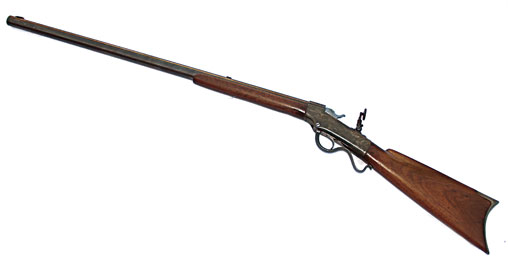
This No. 1½ Hunter’s Rifle sports a 30-inch round barrel and is chambered in .45-70 Gov’t (a 32-inch barrel and .40-65 and .40-63 Ballard calibers were also offered for this model). The original “Rocky Mountain” rear sight has been replaced with an early peep. No. 1½ Hunter’s Models were not factory-equipped with tang sights. The receiver exhibits non-factory period engraving and is devoid of finish, although edges and stampings are sharp.
Ballard serial number records are incomplete, but the “J. M. Marlin” stamping indicates manufacture between 1875 and 1881; after that, receivers were stamped “Marlin Fire Arms Co.” A chip in the stock heel has been repaired, and the rebrowned barrel exhibits sharp rifling. Overall condition, plus a desirable caliber, makes this 60 percent rifle, which originally sold for $22.50, easily worth $2,500.
Gun: Ballard No. 1½ Hunter’s Rifle
Serial No. : 13XXX
Caliber: .45-70 Gov’t
Condition: 60 percent (NRA Very Good - Antique Firearm Condition)
Manufactured: between 1875 and 1881; exact year unknown
Value: $2,500
Most Popular