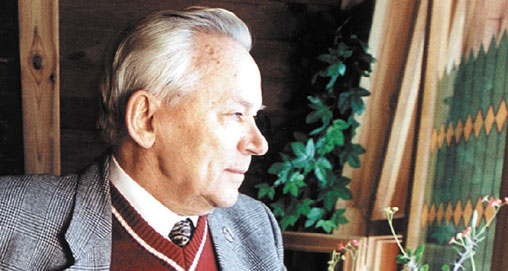
It was regret that I opened an email today announcing the death of Mikhail Timonfeyevich Kalashnikov on Monday, Dec. 23, 2013, in Izhevsk, Russia. He was 94. At one time, a wounded Russian tank sergeant sketching ideas out while recovering from wounds received during “The Great Patriotic War,” he rose to become the designer of the world’s most produced firearm design-the Avtomat Kalashnikova. Developed to defend his “Mother Russia,” it became the Soviet Union’s most lasting export. Estimates vary, but it is thought that more than 100 million guns based on Kalashnikov’s design have been produced worldwide. I met and shook hands with Kalashnikov at trade show years ago, and through an interpreter found him to be gregarious and engaging. The regime for which he designed the gun was indeed, in President Ronald Reagan’s words, an “Evil Empire,” but the world’s alignment changed greatly during Mikhail Kalashnikov’s long life. There is no doubt that the peasant boy that rose to be a lieutenant general was one of the greatest arms designers of the 20th century.
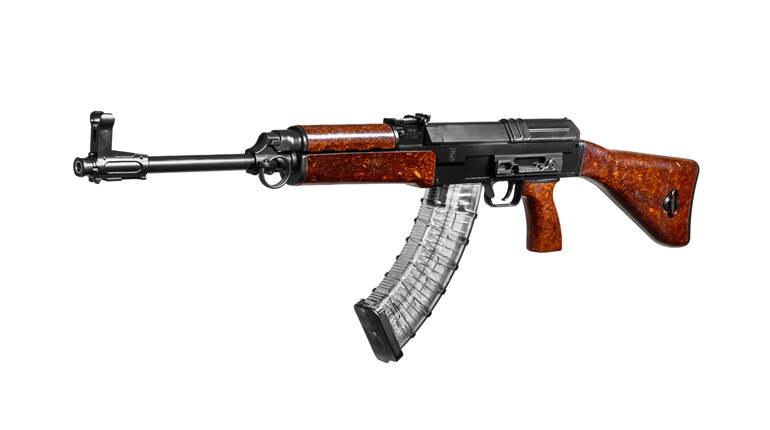
The gun designed by Kalashnikov (and those in the design bureau working with him) emerged onto the world stage in 1956 during the Hungarian Uprising, as Soviet troops crushed the rebellion there. The gun went on to become a symbol of Soviet power and communist ideology, a rugged, reliable design that was well suited to its intended role as an infantry arm in the hands of peasant conscripts. It was selective fire, chambered for the intermediate 7.62x39 mm cartridge, and easy to understand and operate. How revolutionary was it? You can find it on Mozambique’s flag.
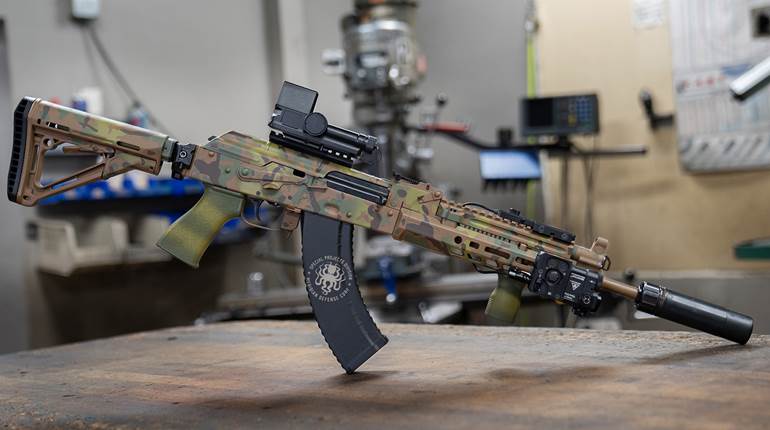
The end of the Cold War and the collapse of the Soviet Union left Kalashnikov as likely one of the most well-known brands to come out of Russia in the last 60 years, but it had limited commercial success. There was a magazine called Kalashnikov, and there have been knives, vodka and other non-gun products. My friend and former American Rifleman Technical Editor Mike Bussard brought me a bottle of the first Kalashnikov vodka, which he claimed fit in a Russian army canteen cover. Sure enough when I brought it home, I tried it in a World War II Soviet canteen cover, and it fit just as advertised. I even picked up an air soft “KALSHNIKOV” made in China and rendered in brittle plastic for a birthday present a few years back. And of course, many semi-automatic-only versions of the AK have been offered by various importers. Oddly enough, there are at least two firms producing semi-automatic versions of the AK here in the United States today.
And he was an NRA Life member who, in a 1999 speech on his 80th birthday, forcefully reiterated his firm support for the right to keep and bear arms by private citizens all over the world.
If you want to have a look at both the social and historical implications of Kalashnikov and his rifle, I highly recommend The Gun by C.J. Chivers, who is a Pulitzer prize winner. It is a well-researched and brilliantly written book.
Most Popular